Innovation
The definitive glossary of motorsport technology from ABS to zylon
by Raceteq
20min read

Ever wondered what makes a Formula 1 car stick to the track at 300 kilometres per hour, or why engineers obsess over invisible spirals of air? This is the fascinating world of motorsport technology, the factors that have separated champions from also-rans.
Sign up for a newsletter and we'll make sure you're fully up-to-date in the world of race technology
Jump to letter:
A | B | C | D | E | F | G | H | I | K | L | M | N | O | P | R | S | T | U | V | W | Y | Z
A
ABS
Anti-lock braking system. This prevents the car’s wheels from locking up under hard braking. Some racing series such as Formula 1 do not use ABS.
Aerodynamics
This is the way a fluid - in this case air - reacts with solid bodies. In motorsport terms, engineers use aerodynamics to influence how air flows around the car, whether that generates drag, downforce, or leads to other behaviours. Aero is the shortened version of aerodynamics and can be used to denote parts of bodywork.
Apex
This is the part of a corner that the racing line - the optimal line around a corner or circuit - meets. Drivers generally want to hit the apex of the corner before exiting it.
Armco
Armco is a manufacturer of barriers for the road and racing circuits, but its use has become synonymised with barriers to the point that it’s used interchangeably.
Axle
The axle is the shaft that connects the wheels of a car. It can include a differential or driveshaft.
B
BHP
Short for brake horsepower. This is a measure of an engine’s power output that accounts for losses due to friction and other factors. BHP is generally lower than horsepower (HP).
Brake
A mechanical device that slows down or stops the vehicle by creating friction, typically between brake pads and a rotor. This process converts the vehicle's kinetic energy into heat, allowing the vehicle to slow for a corner or stop entirely.
C
Centre of gravity
Often shortened to CoG, centre of gravity refers to the concentration of an object’s weight - where the force of gravity acts on the object. It is an important factor in designing a motorsport vehicle as, to enhance handling, CoG needs to be as low as possible and as close to the middle of the car as possible.
CFD
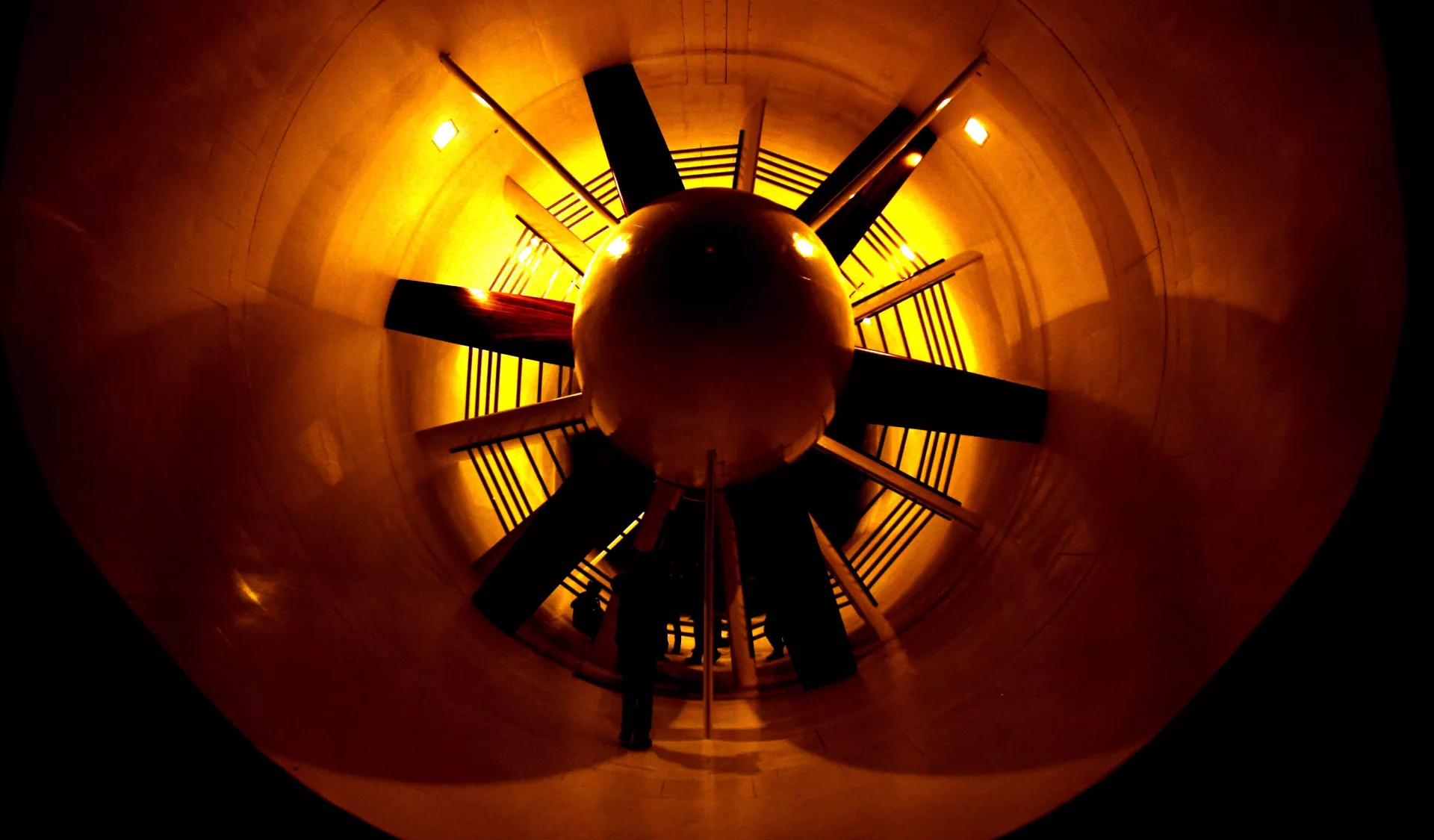
Computational Fluid Dynamics. A way to simulate and analyse fluid flows (including airflow) to predict and visualise how fluids interact with surfaces in various conditions. Read more.
Clutch
A mechanical device that connects and disconnects the engine from the transmission, allowing the driver to change gears smoothly. It enables the engine to run while the vehicle is stationary and helps control power transfer to the wheels.
Cola/Coke bottle
Term used to describe the tapered, bottle-like rear profile of modern single-seater racing cars. Read more.
Compression ratio
The ratio between the total volume of a cylinder when the piston is at the bottom of its stroke (bottom dead centre) versus the volume when the piston reaches the top (top dead centre).
A ratio of 10:1, for example, means the air-fuel mixture is compressed to one-tenth of its original volume before ignition. The higher the compression, the more violently the mixture ignites and the more energy is extracted from each combustion cycle - which is why higher compression ratios generally produce more power.
The trade-off is that highly compressed mixtures can ignite before the spark plug fires, a destructive phenomenon known as knock or detonation.
Road cars typically run compression ratios of between 10:1 and 13:1; naturally aspirated Formula 1 engines historically exceeded 14:1. Turbocharged engines run lower ratios - often 9:1 to 10:1 - because the turbocharger is already forcing more air into the cylinder, effectively raising the pressure at the point of ignition.
/xpb_1314694_hires.webp?cx=0.48&cy=0.64)
D
Dakar Rally
This is a gruelling off-road endurance racing event in which cars, trucks, quad bikes and other vehicles compete to set the fastest times over a route and its combined stages. It takes place in Saudi Arabia but has previously been held in South America, Europe, and Africa. The first Dakar Rally was held in 1979, when it was known as the Paris-Dakar Rally.
Differential
The differential transmits torque from an engine to the wheels. It can split the torque between wheels, allowing for slip. It can also be tuned to have the wheels slip at different rates. An open differential allows both wheels to rotate at different speeds; a limited-slip differential locks this rotation at a certain point; and a locked differential locks the wheels together to turn at the same rate.
Downforce
A downward-facing aerodynamic force that pushes a racing car towards the track, increasing grip. It is the opposite of lift. Downforce is generated when there is a low-pressure area of flow beneath a surface and a high-pressure area above. It squares with the speed of a vehicle.
Drag
Aerodynamic resistance that opposes a vehicle's motion through the air.
Drag coefficient
Denoted as Cd. Drag coefficient is a way to measure the resistance to a vehicle as it passes through air.
Driveshaft
This is the part of the car that transmits power from the engine to the wheels. It is part of the drivetrain.
Drivetrain
The system that transmits power from the engine to the wheels, using the transmission, driveshaft, axles, and differential.
DRS
DRS is the drag reduction system, an overtaking aid used in Formula 3, Formula 2, and Formula 1 (until 2026) that opens a flap in the rear wing to reduce drag, increase top speed, and give the driver of one car a chance to pass another.
E
ECU (Engine Control Unit)
The computer that manages engine parameters, ensuring performance and reliability.
Engine cover
Bodywork that houses the engine and related parts. The engine cover is sculpted to enhance aerodynamic properties, whether on a Formula 1 car or endurance racing car.
ERS
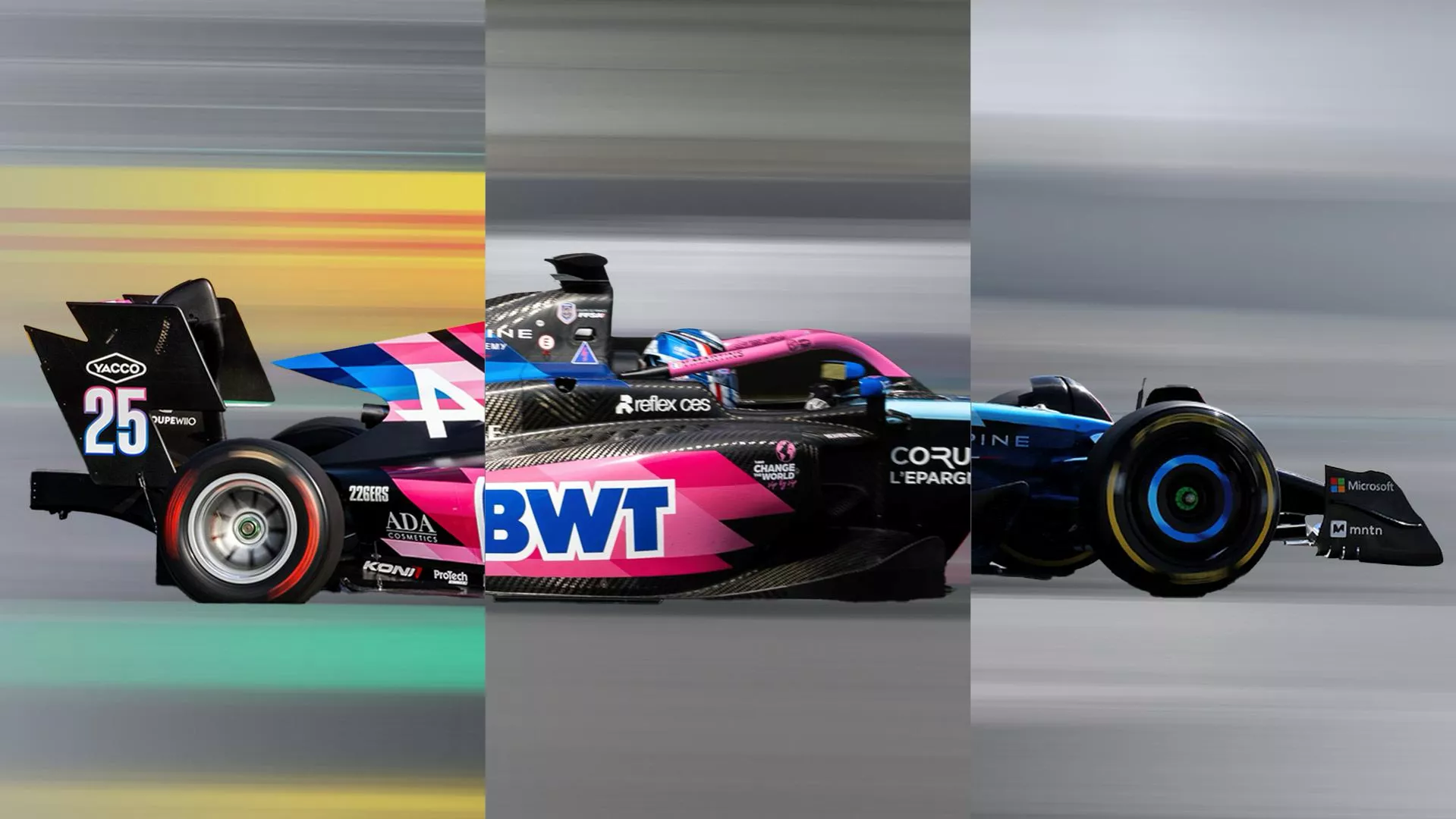
The Energy Recovery System (ERS) is a Formula 1 component that comprises the parts that recover waste energy and store it in a battery to be deployed later on.
F
F-Duct
The F-Duct was an innovation used by McLaren in the 2010 Formula 1 season. It allowed the driver to block a hole in the cockpit, directing airflow to the rear wing through the engine inlet at the top of the rollhoop. The air would blow through a slot in the rear wing and stall it, dramatically reducing drag and downforce and giving the car a top speed advantage. Through corners, the wing would operate as normal. The device was banned in 2011 due to concerns over driver safety as they would need to use one hand to block the duct in the cockpit while operating the car.
The F-Duct was named so as the forward-most inlet duct was mounted on the ‘f’ of the Vodafone logo on the McLaren MP4-25.
FIA (Federation Internationale de l'Automobile)
The governing body for world motorsport, responsible for setting rules, safety standards, and organising championships across the various FIA formula categories. Based in Paris, it oversees everything from technical regulations to race procedures.
Formula
A set of rules and regulations that define the technical specifications for racing cars in a particular category (engine size, weight, aerodynamics, and more).Formula 1
The highest level of international single-seater motorsport featuring open-wheel racing cars built by constructors such as Williams and McLaren, which compete for the constructors’ championship. Engine manufacturers such as Mercedes and Ferrari supply the constructors. Drivers including Max Verstappen and Lewis Hamilton compete for the drivers’ championship. Races are known as sprints or grands prix and held at circuits around the world.F1 Academy
All-female racing series launched in 2023 to support and develop female drivers in motorsport. It uses identical Formula 4-level cars and aims to create a pathway for women to progress through motorsport's higher levels. F1 Academy races take place during F1 weekends at the same circuits.Formula 2 (F2)
The primary FIA-run feeder series to F1, featuring identical cars with 620hp turbocharged engines. It serves as the main stepping stone for drivers aiming to reach Formula 1, with many current F1 drivers having competed here first. F2 races take place during F1 weekends, at the same circuits.
Formula 3 (F3)
A junior open-wheel racing category below F2, using standardised cars with naturally-aspirated engines producing around 380hp. F3 races take place during F1 weekends, at the same circuits.
Formula 4 (F4)
Entry-level single-seater series for young drivers (typically 15-18 years old) transitioning from karting. Cars are relatively simple with around 160-180hp engines, focusing on teaching fundamental racing skills.
Formula Regional (FR/FRECA)
A category between F4 and F3, featuring more powerful cars than F4 (around 270hp) but less complex than F3. It provides another developmental step for young drivers in various regional series worldwide.
Flags
Communication system that conveys messages to drivers while they are racing. Marshals wave physical flags and drivers might be able to view digital flags around the circuit or on their heads-up display during a race. Key flags include yellow (caution/danger), red (session or race stopped), green (race start/all clear), chequered (race finish), blue (faster car approaching), and black (driver penalty/disqualification).
Fuel
This is the substance that can be consumed to provide energy. In motorsport, fuel is generally a fluid such as petroleum, a concentrated store of chemical energy that is mixed with air and ignited within the engine. Alternative fuels such as hydrogen (stored in liquid form) are also being explored within motorsport and mobility.
Fuel injection
The system that delivers fuel to the internal combustion engine. It is electronically controlled and directly introduces fuel into the engine’s combustion chamber.
G
G-force
A measure of acceleration relative to the force of gravity at Earth's surface, where 1G equals 9.81 metres per second squared. It is not strictly a force, but a way of expressing how much load the body experiences during acceleration, braking, or cornering.
Under 5G of braking, for instance, a driver's body effectively weighs five times its resting mass - meaning a 70kg driver experiences around 350kg of force pressing them forward into the harness. Formula 1 drivers regularly sustain lateral G-forces of 4 - 6G through high-speed corners, requiring significant neck and core strength to maintain head and body position.
Under heavy braking from high speed, peak values can exceed 6G momentarily. Sustained exposure compounds fatigue across a race distance, particularly at circuits such as Suzuka or Silverstone where high-speed corners follow one another in quick succession.
In a severe accident, G-forces can reach 50G or beyond in fractions of a second, which is precisely why structures such as the monocoque, HANS device, and halo are engineered to absorb and distribute those loads rather than transfer them directly to the driver.
Gearbox
Also known as a transmission, the gearbox encases a set of gears and its controls to convert the engine’s power to other driven components in the drivetrain. In most cars, the gearbox transmits power to the driveshaft.
Gear
A gear is a device that transmits and modifies torque and rotational speed using interlocking teeth.
In a car's transmission, the input gear connects to the crankshaft, and different combinations of gears create various ratios.
Using the gearshift - normally electronically or hydraulically linked paddles in a racing car, or a shifter - the driver selects which gear ratio to use, determining whether to favour torque or speed.
Gear ratio
Gear ratios determine how torque and speed are traded off between the input and output gearbox.
Torque is force multiplied by distance.
If 10 lb-ft of torque is applied by the engine to the crankshaft’s gear of one inch in radius, and that gear transmits that torque to a gear of four inches in radius, the large gear applies 40 lb-ft of torque.
However, as that torque is transmitted from a 1-inch gear to a 4-inch gear, that torque is transmitted with greater leverage. A larger gear therefore turns more slowly, but with more force.
That’s why larger gear ratios favour torque over speed - but that rotational force is what’s needed to move the wheels of a stationary car. Generally, the first gear of a car has the largest ratio for that reason.
At higher gears, smaller gear ratios (which would be denoted like 0.56:1) are used that favour speed at the expense of torque.
Ground effect
An aerodynamic phenomenon that generates downforce by utilising the design of a vehicle's underbody, particularly through the use of Venturi tunnels and shaped floors.
Gurney flap
The Gurney flap - named after its inventor, F1 driver Dan Gurney - is a small tab projecting from the trailing edge of a wing, at a right angle to the surface of the wing. It increases downforce generated by the wing by reducing flow separation at the very edge of the surface.
H
HANS device
Head and Neck Support device. A collar-like restraint worn by drivers that connects their helmet to the seat harness via straps, limiting the forward movement of the head in a frontal impact and reducing the risk of serious neck and spine injuries.Horsepower
See Power
I
Intercooler
A device that cools compressed air from a turbocharger or supercharger before it enters the combustion chamber of the engine.
Internal combustion engine
Also known as the engine, the internal combustion engine (ICE) combines air and fuel to produce power. Alternative power units such as hydrogen or electric power units are also used in motorsport, while Formula 1 cars use a hybrid component alongside the ICE.
K
Kerb (US spelling: curb)
Kerbs or curbs are raised or bumpy strips on the edges of corners, marking the boundaries of the circuit. They can be made of concrete, asphalt, or even metal, and kerbs can prove slippery in wet conditions.
KERS
KERS stands for Kinetic Energy Recovery System. This system recovers and stores braking energy for engine deployment, providing a boost of power. It was used in F1 from 2009 to 2013. Similar systems were used in sportscar and endurance racing, and even deployed in London buses.
L
Limited-slip differential
A limited-slip differential (LSD) allows the wheels to turn at different rates but limits just how much they can slip to force one wheel to grip.
Locked differential
Often used in offroad racing disciplines, locked differentials force the wheels to rotate at the same speed, forcing traction, and allowing them to grip over steep or slippery terrain.
M
MGU-H
Motor Generator Unit - Heat or MGU-H is a part of the Formula 1 Energy Recovery System that converts waste heat from exhaust gases to electrical energy for deployment. It was used in F1 from 2014 to 2025, and removed from the F1 power unit in 2026.
MGU-K
Motor Generator Unit - Kinetic or MGU-K is a part of the Formula 1 Energy Recovery System that recovers braking energy and stores it as electrical energy for deployment. It has been used in F1 since 2014 but, from 2026, will provide a higher percentage of the engine's power given the removal of the MGU-H
Monocoque
A single-piece structural shell in which the bodywork itself forms the chassis. Used in most modern racing cars, it is rigid, lightweight, and integral to crash protection. In 1962, the Lotus 25 became the first F1 car to feature a fully stressed aluminium monocoque. Although aluminium-honeycomb monocoque chassis are still in use, the majority of monocoques today are constructed from carbon-fibre - technology pioneered by McLaren in 1981 for the MP4/1 F1 car. Read more.N
Naturally aspirated
A term used to denote an engine that does not have forced induction, such as a turbocharger or supercharger.
O
Oversteer
A handling condition in which the rear tyres lose grip before the front tyres, causing the car's tail to step out through a corner. In extreme cases this leads to a spin. In North America, drivers and engineers might describe a car as feeling 'loose' instead of inducing oversteer.
Famous quotes (often attributed to rally driver Walter Rohrl) summarising oversteer and understeer include:
"When you see the tree you're driving into, you have understeer, but if you can hear it, you have oversteer."
"Understeer is when you hit the wall with the front of your car. Oversteer is when you hit the wall with the back of your car."
P
Pitch
Rotation of a car around its lateral axis, defining the location of a car’s nose relative to its tail.
Pitstop
A brief event during a race where a car stops in the pits for tyre changes, repairs, or other necessary adjustments. In some motorsport championships, drivers also pit to refuel. F1 banned refuelling in 2010. Pitting is central to race strategy and pitstop timing can drastically affect a race’s outcome.
Power
Power is the rate of work - energy over time. It can be measured in horsepower (HP) or kilowatts (kW).
HP = torque (lb-ft) x RPM ÷ 5252.
kW = torque (Nm) × RPM ÷ 9549.
What does this say about power? It means that power is proportional to the rate at which the engine is spinning (RPM) and the rotational force generated by that engine. The numbers 5252 and 9549 are mathematical constants - much like pi is - derived from James Watt’s original calculations of horsepower in 1782.
RPM is the multiplier. An engine will therefore produce low power even if the torque is high at low RPM. When RPM is higher, engines can produce higher power.
At 5252 RPM, torque and horsepower are equal. At an RPM below 5252, torque is greater than HP, and vice versa.
Power is not limited by RPM nor torque, but by myriad factors including engine strength, fuel, fuel flow and air flow.
Cars are geared to produce more torque - pulling force - at lower gears.
Pullrod and pushrod
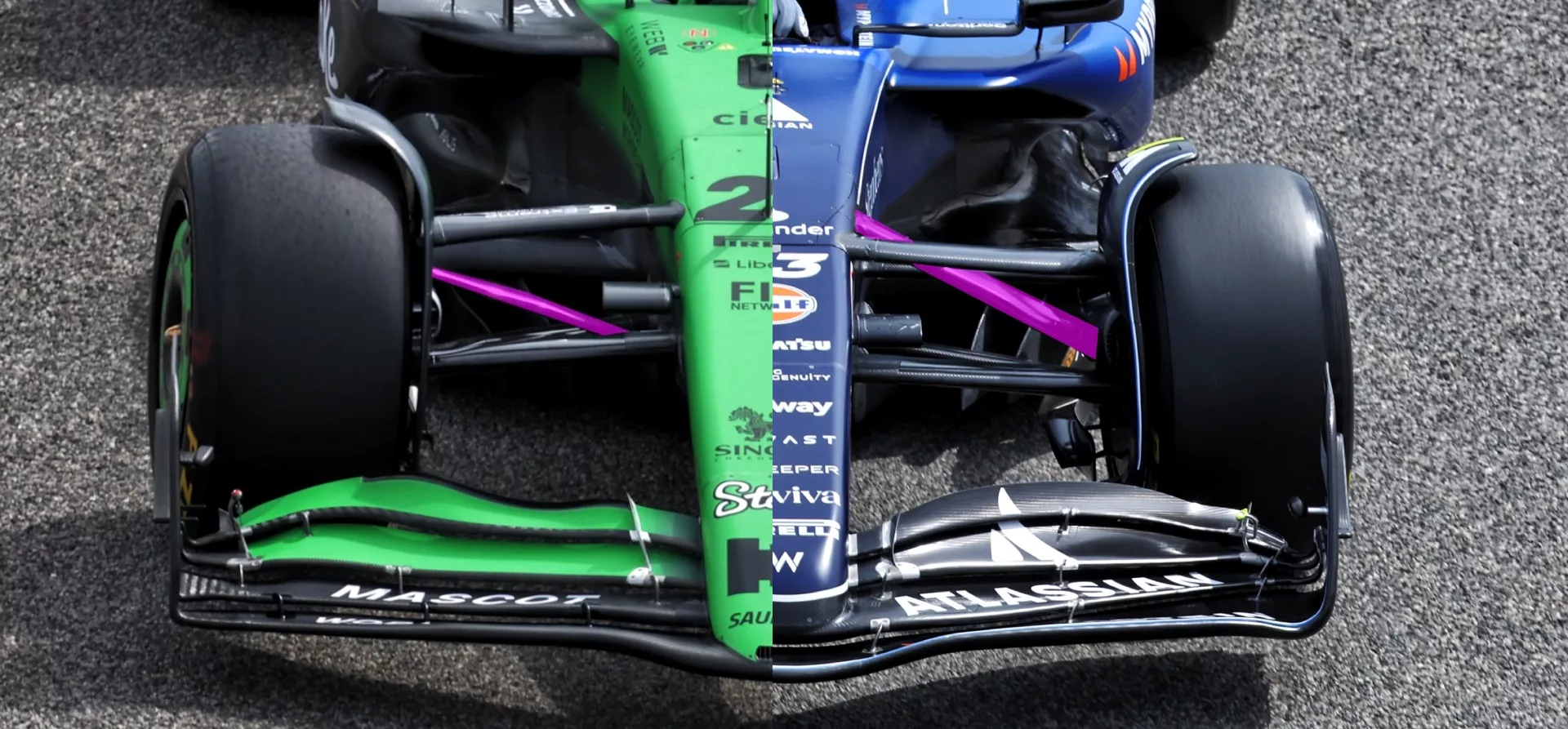
Suspension layouts used in racing cars, particularly Formula 1, where bespoke suspension set-ups are produced by teams. In a pushrod suspension system, the suspension wishbones are mounted below the main spring; in a pushrod system the suspension wishbones are mounted above the main spring.
Pushrod suspension compresses the main spring and pullrod suspension expands the main spring. Each system has tradeoffs in terms of aerodynamic packaging, mechanical efficiency, ease and cost of design, and centre of gravity.
R
Rake angle
The deliberate pitch of the car's chassis, with the rear sitting higher than the front. Teams use rake to influence underbody airflow and downforce generation, though the optimal approach varies by car concept. A higher rake means the rear-front angle is steeper. This can also account for 'dive' under braking, where a car pitches forward under deceleration.
Rev limiter
The device that protects combustion engines by restricting the maximum RPM - revolutions per minute.
Roll
The rotational movement of a vehicle's body around its longitudinal axis (the imaginary line running from front to back through the centre of the car), particularly visible through cornering.
Roll cage/Rollcage
A framework of metal tubes surrounding the driver's compartment, designed to protect the occupant if the car rolls or is involved in a heavy impact. Mandatory in most circuit and rally disciplines - and sometimes incorporated into the chassis instead of being exposed, as is the case in many single-seater championships.
S
Safety car
The safety car leads a field of racing cars during pace or formation laps, caution periods, and during hazardous weather conditions. It is normally a high-performance sportscar model. In F1, the safety car was first deployed at the 1973 Canadian Grand Prix, although the 1911 Indianapolis 500 was the first major motorsport event to use a safety car.
Sharkfin
The sharkfin is a piece of bodywork mounted above the engine cover to add stability to the rear of the car while cornering, when airflow isn’t ‘straight’ down the centreline of the car. Formula 1 cars and LMP1 cars are two examples of racing cars that have had sharkfins.
Sidepod
Bodywork structures on the flanks of racing cars that provide a structural and aerodynamic function. Furthermore, they may contain cooling technology such as radiators, and provide crash protection for drivers.
Spoiler
An aerodynamic device that ‘spoils’ unwanted airflow, particularly at the rear of a racing car. Spoilers prevent buildup of low-pressure airflow and prevent lift from being generated, thus enhancing downforce.
This term is used interchangeably with ‘rear wing’ in many cases, but rear wings generate downforce while spoilers prevent lift.
Supercharger
Superchargers compress intake air to allow the engine to produce more power. Superchargers are powered by a belt connected to the crankshaft. Another example of forced induction.
Suspension
The system, including springs, dampens the effect of bumps and surface changes on the chassis of a car. Without suspension, the chassis would be a fixed mass; suspension allows relative motion between the wheels and chassis, enabling the car to absorb bumps and transfer weight during phases of cornering and motion.
T
Toe-in/Toe-out
A wheel alignment setting describing whether the leading edges of a pair of wheels point toward each other (toe-in) or away from each other (toe-out). Adjusting toe affects stability, turn-in response, and tyre wear. In 2020, the Mercedes F1 Team made headlines by debuting a device called 'Dual Axis Steering', or DAMS. This allowed its drivers to change toe angle on the fly by pulling the steering wheel towards them - but was quickly outlawed for safety reasons.
Torque
This is a turning or rotational force. In a car, that force is applied to the driveshaft, and therefore wheels. Higher torque means a higher rate of turning. Torque equals force multiplied by distance. This is best illustrated using the example of a lever and a heavy object, such as a spanner/wrench and a bolt.The longer the lever is from the turning point, the easier it is to move the object around that point. The shorter the lever is, the harder it is to rotate that object. Torque is the force of that rotation. A longer spanner means more turning force.
Torque is measured in Newton metres (Nm) or pound-feet (lb-ft). Tap here to see how torque relates to power. Or tap here to see the relationship between torque and gears.
Traction
Grip between the car’s tyres and track surface. This is friction, allowing the car to apply its power through the wheels without sliding.
Traction control
An electronic system that controls engine power or modulates wheels to prevent wheelspin when the throttle is applied. Traction control is used in disciplines such as sportscar racing, but not in F1 nor its feeder series.
Turbocharger
A device (also known as the turbo) that compresses air from the exhaust and feeds it back into the engine, allowing it to produce more power. Turbo lag is a delay between the throttle input and the turbo spooling up.
Turbos can come in various forms including twin-turbo and variable geometry turbo.
A turbocharger is an example of a forced induction system.
U
Underfloor
The surface below a racing car, shaped to manage airflow underneath the car. Many motorsport series use flat underfloors to control the amount of downforce generated by the underfloor, itself a low-pressure zone that can work to generate downforce; in Formula 1 from 2022 to 2025, underfloors comprise Venturi tunnels that generate a great deal more downforce than a flat-bottomed floor.
Understeer
A handling condition in which the front tyres lose grip before the rear tyres, causing the car to run wide of the intended line through a corner. Often described by drivers as the car 'pushing' or 'washing out'. In North America, drivers and engineers might describe a car as feeling 'tight' instead of inducing understeer.
V
Venturi effect and Venturi tunnel
A fluid dynamics principle named after Italian physicist Giovanni Battista Venturi. It says that as fluid flows through a narrower area, velocity of the fluid increases, creating a zone of low-pressure flow through that constricted area.
A Venturi tunnel - particularly prevalent in F1 car underfloors from 2022-25 and in design of numerous racing cars - harnesses this effect by accelerating air through an area and creating a zone of low pressure. Combined with the zone of high pressure above the surface, this generates downforce.
Vortex
A spiralling flow of air created when fluid (such as air) moves around or past a surface. It is a useful aerodynamic effect that can be used to seal areas of airflow or speed up airflow.
W
Wing
Aerodynamic device that generates downforce on a racing car. Front wings are mounted around the nose of a car, conditioning airflow for the rest of the car; rear wings are mounted at the back and typically generate more downforce than their opposite counterparts.
Wing angles can be adjusted to change the amount of downforce generated, depending on a circuit’s demands.
Y
Y250 Vortex
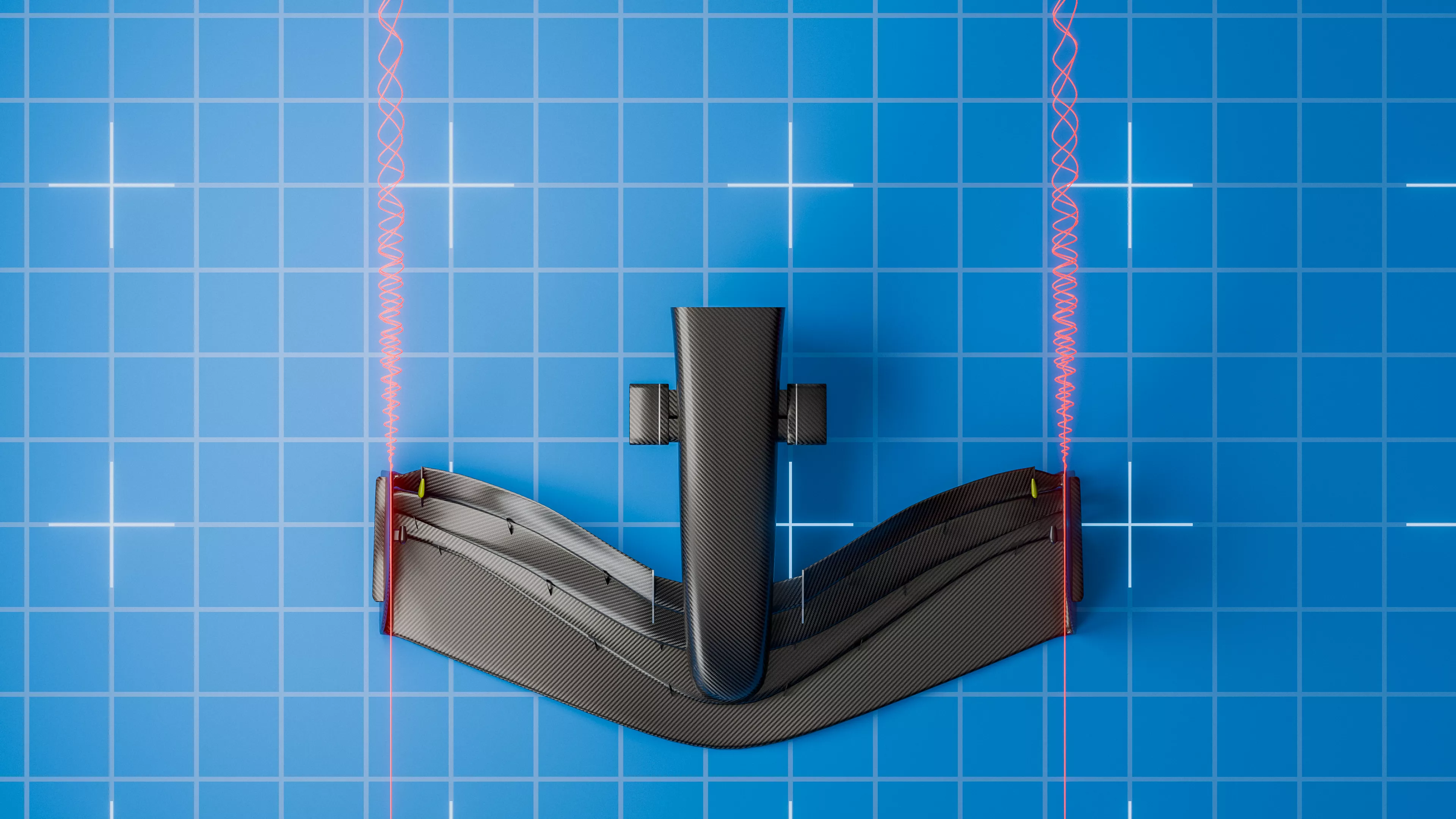
A spiralling column of air generated by the front wing, named after its point of origin - 250 millimetres from the car’s centreline or Y coordinate. This vortex was harnessed by F1 teams before ground effect-focussed regulations were implemented from 2022 to 2025.
Yaw
Rotation of a vehicle around its vertical axis, used to denote the direction of a car’s nose left or right relative to its direction of travel.
Z
Zylon
A high-strength synthetic fibre used to reinforce drivers’ helmets in motorsport or to reinforce the tethers that connect wheels to cars. Zylon has been used in F1 cars since 2001 and mandated inside F1 drivers’ helmets since 2009, when Felipe Massa survived an incident that saw debris pierce his visor.

/fw14b-track-logo2.webp?cx=0.5&cy=0.5)