Motor
Decoding gear ratios - and what McLaren’s F1 gear choice reveals
by Matthew Somerfield, Edd Straw
8min read
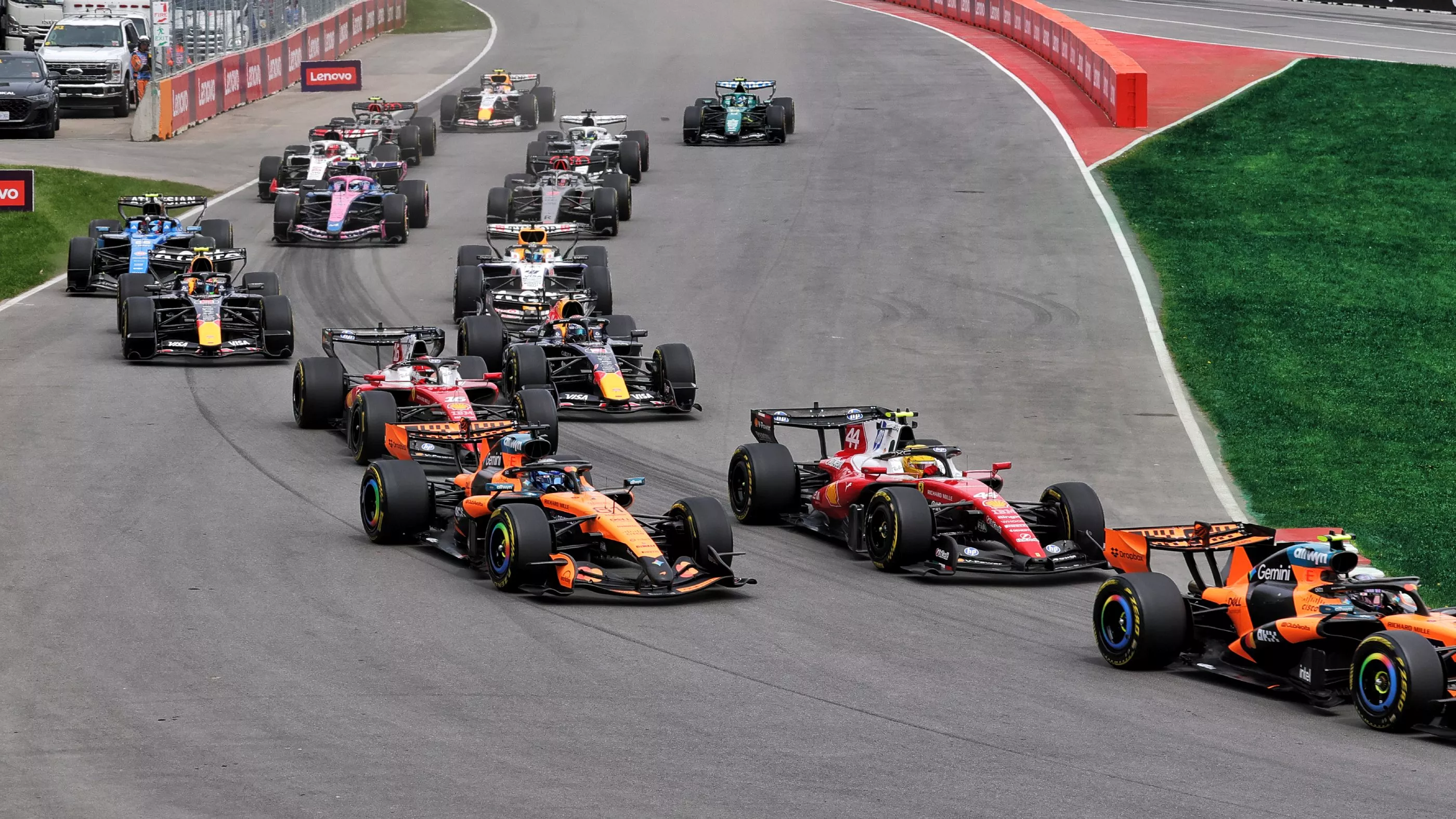
Formula 1’s cyclic performance swings are often driven by two regulatory factors, the larger, overarching regulation changes that define an era and the smaller, year-on-year alterations that the sport has a penchant for making in order to fix issues that have arisen when they’re put under the duress of competition.
Sign up for a newsletter and we'll make sure you're fully up-to-date in the world of race technology
However, there’s often some, more innocuous regulations, that might not have changed between eras that can also have an impact on the competitive landscape.
One such sporting
aspect that’s recently come to light in this regard relates
to gear ratios and how teams, which should be more or less aligned
owing to their technical alliances, are often looking to exploit the
situation for their own gain.
The fundamentals of gear ratios
Gearboxes control how engine power reaches the wheels by constantly trading speed for torque (pulling power).
Torque multiplies are
based on gear size. If a one-inch driving gear with 10 lb-ft of
torque turns a 4-inch driven gear, it produces 40 lb-ft of torque.
This is a 4:1 gear
ratio.
The larger gear
delivers four times the force, but spins at one-quarter the speed,
prioritising acceleration over top speed.
Cars step down through
a sequence of ratios as you speed up:
Low gears (e.g.,
4:1) have high torque but low speed. That’s perfect for getting a
heavy car moving from a standstill.
Direct drive
(1:1) is where the input and output gears spin at the same speed.
This is usually found in 4th or 5th gear.
Overdrive (e.g.
0.5:1) is where the output spins faster than the engine. This trades
pulling power for highway speed and fuel efficiency (which is why
pushing the accelerator in top gear produces very little
acceleration).
The final drive is the
last gear before the wheels, usually in the driven axle assembly. It
serves as the ultimate torque multiplier.
The transmission and
final drive work in tandem to determine the car’s overall ratio. If
first gear is 3:1 and final drive is 4:1, the engine must spin 12
times (3x4) to turn the wheels exactly once. The final drive can be
tweaked to favour speed or acceleration depending on the needs of the
driver.
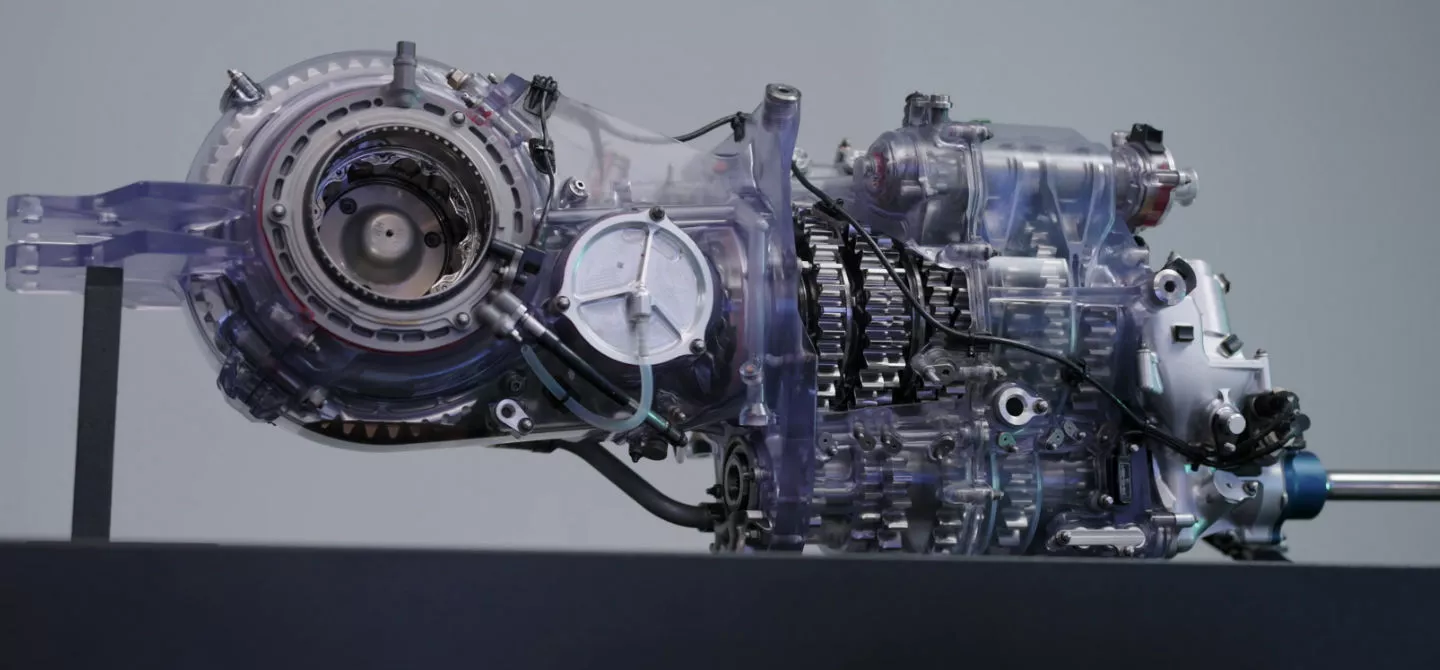
A Mercedes F1 gearbox with a transparent case to help showcase its internal gears
How the Formula 1 regulations shape gear ratios
F1 teams now have to nominate their gear ratios for the season before the first race and for 2026 can make one change to their gear ratio and final drive selection during the season.
For 2027 and beyond they may make changes to the gear ratio pairs, or to the final drive, but not both at the same time.
According to the regulations there must be eight forward gear ratios, which must be made from steel, whilst they also stipulate that “All cars must be able to be driven in reverse by the driver at any time during the Competition”.
The wording here is necessary in order to force the teams to include a reverse gear, albeit as it’s not fulfilling a performance function they're much more delicate than their forward counterparts and made smaller and lighter in order to save weight, seeing as they’re rarely used.
This results in a more lengthy selection process, often with the driver having to cycle through several functions on the steering wheel and prevents them from being able to inadvertently select reverse.
How do teams F1 determine their gear ratios?
In terms of the decisions made on the forward gear ratios, there’s a whole host of parameters that have to be taken into account, all of which require a solid understanding of the performance envelope of the car’s chassis, aerodynamics and power unit.
A significant factor in deciding the gear ratios will be the acceleration profile they’re looking for and how close the team wants to get to the car’s theoretical top speed. They must also take into account the tractive and resistive forces, such as the drag coefficient or air density.
An optimum selection of ratios and final drive could be formulated from here, assuming an F1 car was only travelling in a straight line or on a single circuit. But, as we know, there’s a wide variety of different circuit characteristics that also have to be considered when determining the ratios.
For example, think of the distinct differences between the slowest and fastest circuits on the calendar and how opting for a shorter set of gear ratios might help at one venue, whereas a longer set might work better at another.
Therefore, the teams will run a whole host of simulations to determine which trade-offs are most acceptable for those given characteristics, whilst building in a window for improvements that are associated with their season long development programme.
It’s not always been this way
This was a much easier endeavour in the pre-hybrid era of the sport, with only seven forward gears employed, rather than eight, whilst teams were also able to nominate 30 different gear ratio pairs ahead of the season, giving them much more flexibility during a given race weekend to make the changes needed for the given circuit characteristics.
Interestingly, one of the narratives that quickly emerged at the beginning of the hybrid era, in 2014, was Mercedes rarely used eighth gear, except on the very longest of straights, suggesting it had tailored its ratios in a unique way.
It did eventually play its ‘joker’, as we call it, with the gear ratios being changed at the 2014 Singapore Grand Prix, some 14 races into a 20-race season.
It’s also worth noting that at this point in time, whilst supplying Williams, McLaren and Force India with its Mercedes power unit, those teams either designed and built their own gearboxes, with Force India having bought its gearbox from McLaren.
This means that Mercedes had the freedom to develop its own gear ratio strategy alongside its power unit, without having to consider the implication this might have on the teams they were supplying power units to.
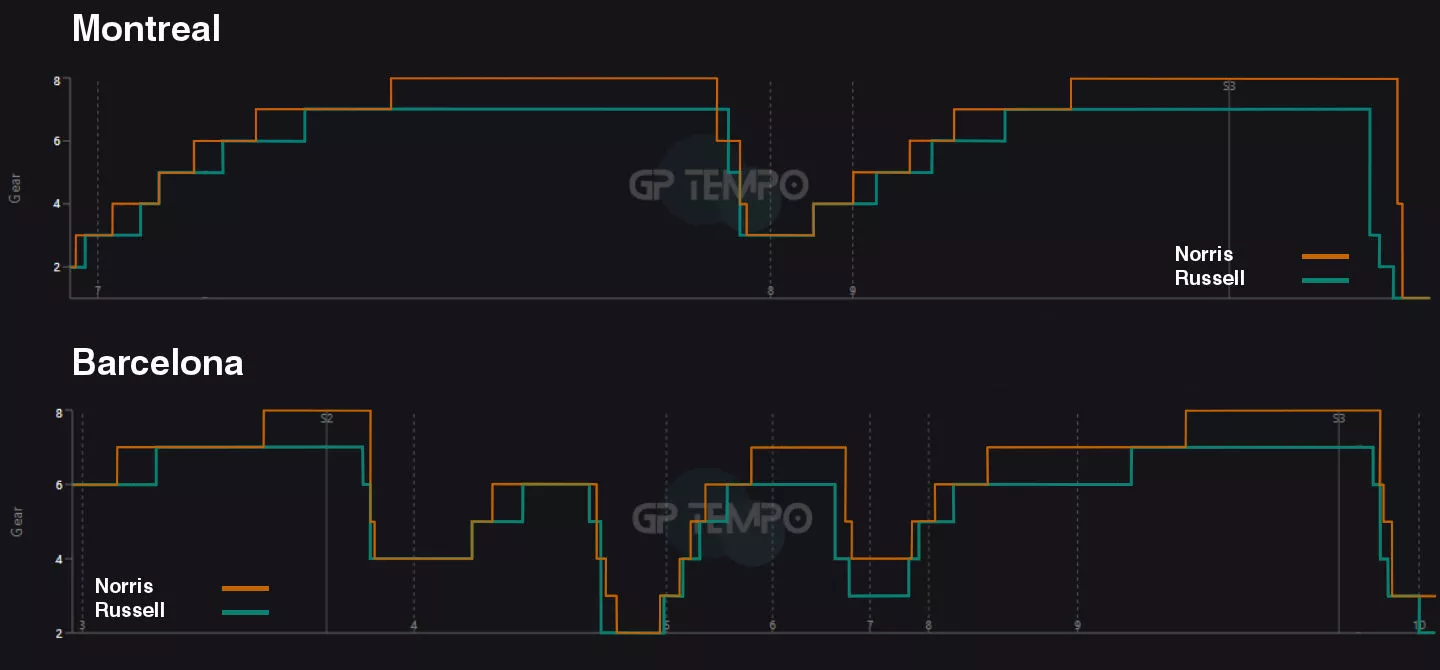
A comparison of the Mercedes and McLaren gear shift traces from their fastest qualifying laps at Montreal and Barcelona 2026. The Mercedes W17 of George Russell is denoted in green, whilst the McLaren MCL40 of Lando Norris is in orange.
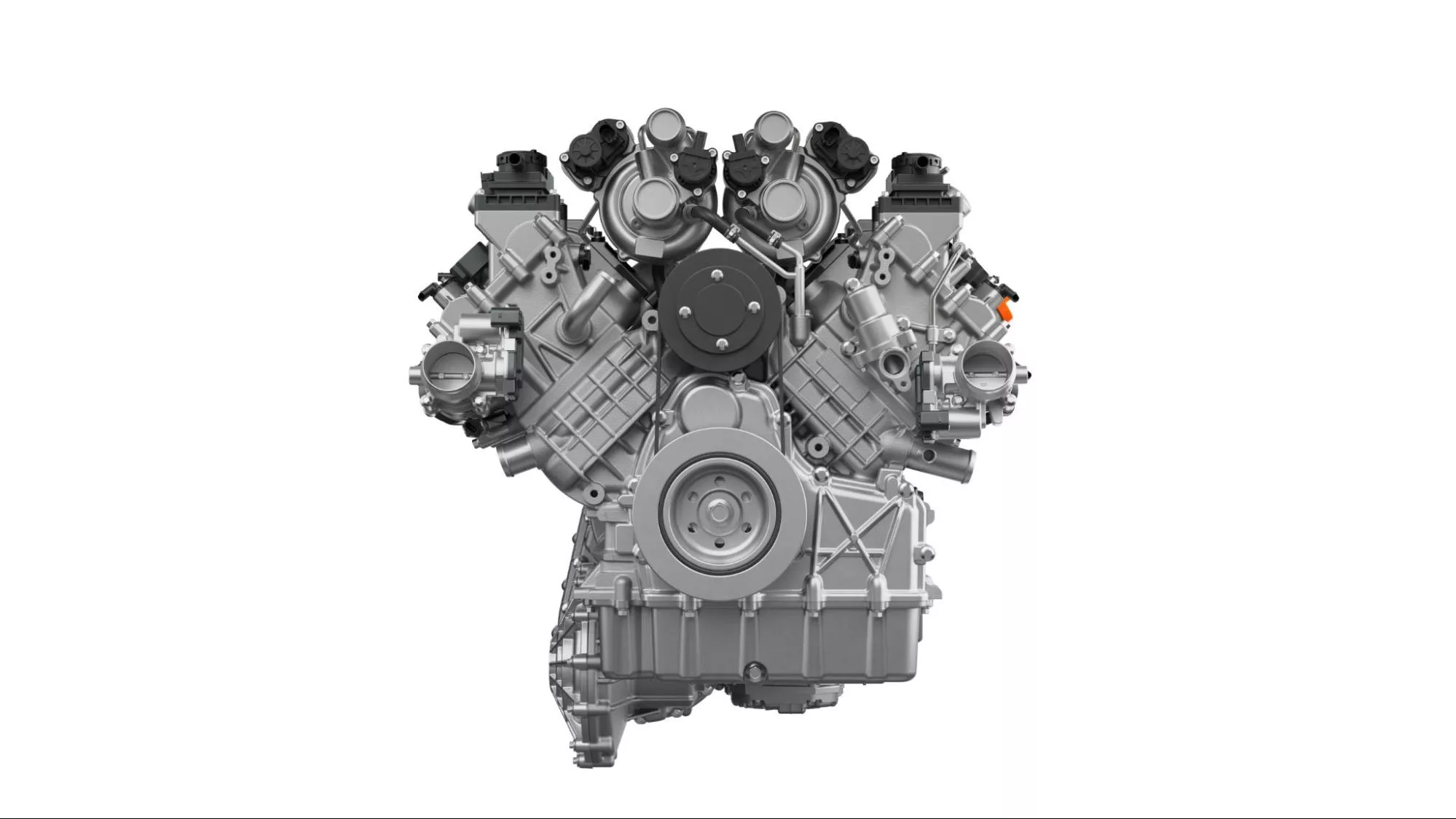
The 2026 F1 gearbox landscape
This discussion brings us nicely around to the disparity that’s arisen with McLaren and the rest of the Mercedes powered teams in 2026, as the Woking-based squad continues to design and manufacture its own gearbox, whereas Williams and Alpine are supplied the same equipment as the works outfit.
If we take a look at the gear trace from the fastest qualifying lap from the Mercedes in Montreal and Barcelona (above), circuits that have their own distinct set of challenges, it’s clear that McLaren’s gear ratios are distinctly different.
From the overlays, which show the corner number on the bottom of the graph and the gear they're in on the left, we
can see just how much quicker McLaren's drivers are getting up through the
gears.
This often results in its drivers being in eighth gear some
time before their counterparts and, on occasions, they’re in eighth
gear when the others don’t get out of seventh gear.
This difference in gear ratios is also going to manifest in further performance disparities between McLaren and its stablemates too, especially given the correlation between these parameters and how the MGU-K (motor generator unit - kinetic) harvests energy under these regulations.
As a consequence, there will be a difference in their ability to deploy that energy throughout the course of a lap too.
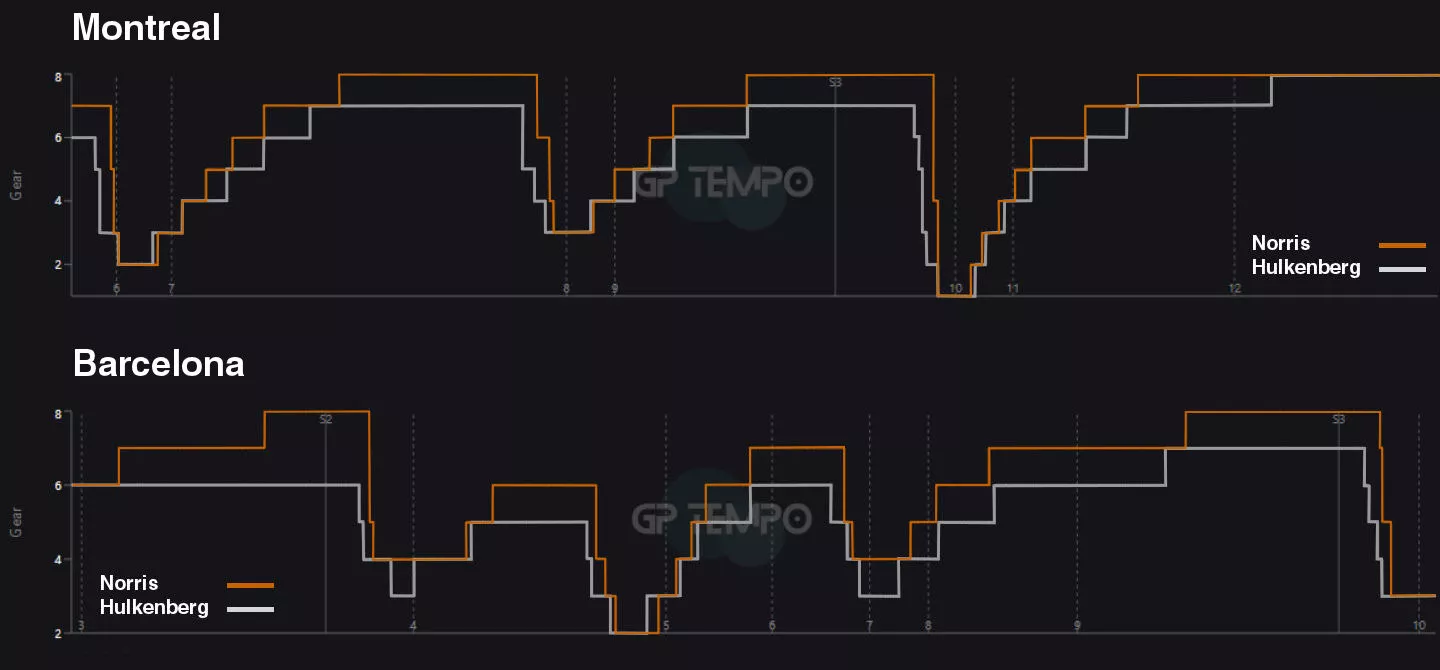
A comparison of the gear shift traces of the fastest qualifying laps for McLaren’s Lando Norris (orange) and Audi’s Nico Hulkenberg (grey) in Montreal and Barcelona.
A clear example of gear ratio differences in 2026
And, whilst it’s clear that McLaren is the team with the shortest ratio selection amongst the Mercedes powered teams, it would also appear it has opted for the shortest ratios on the grid, whilst Audi is on the opposite end of that spectrum, having selected the longest ratios.
The comparison between the two is stark when they’re overlaid in the gear trace snapshot (above). The snapshot captures the gear changes made between turns 5 and 13 in Montreal and between turns 3 and 10 in Barcelona, with the quickest laps of Lando Norris and Nico Hulkenberg used in the example.
Notably the McLaren, in Norris’s hands, reaches eighth gear ahead of Turn 4 in Barcelona, whereas the Audi piloted by Hulkenberg doesn’t even get out of sixth gear.
Meanwhile, there’s further instances throughout the course of these laps where McLaren is selecting one gear more than Audi, as the McLaren gets up through the gearbox quicker than the Audi.
/xpb_1408348_hires-(1).webp?cx=0.5&cy=0.5)
Which F1 teams make their own gearboxes?
It’s worth noting that, amongst all of the technical challenges involved in producing a car for 2026, both Aston Martin and Audi have designed and built a gearbox for the first time in quite a while too.
In both instances they’d purchased equipment from their respective power unit suppliers long before their name went above the door, with an in-house developed solution not being created since 2004 and 2008 respectively.
This means both teams have had to invest, in advance, in the infrastructure and personnel needed for such a project, whilst also establishing and collaborating with new partners to develop the associated lubricants needed for their solutions.
Valvoline and Castrol are providing the respective technical support required by those teams, with the full list of suppliers listed below for each of the teams. A * denotes that the component is built in-house.
| Team | Power unit supplier | Fuel Supplier | Gearbox supplier | Lubricant partner |
| McLaren | Mercedes HPP | Petronas | McLaren* | Motul |
| Mercedes | Mercedes HPP* | Petronas | Mercedes HPP* |
Petronas |
| Red Bull | Red Bull Powertrains* | Mobil 1 | Red Bull Powertrains* | Mobil 1 |
| Ferrari | Ferrari* | Shell | Ferrari* | Shell |
| Williams | Mercedes HPP | Petronas | Mercedes HPP | Petronas |
| Racing Bulls | Red Bull Powertrains | Mobil 1 | Red Bull Powertrains |
Mobil 1 |
| Aston Martin | Honda | Aramco | Aston Martin* | Valvoline |
| Haas | Ferrari | Shell | Ferrari | Shell |
| Audi | Audi* | Castrol | Audi* | Castrol |
| Alpine | Mercedes HPP |
Petronas | Mercedes HPP | Petronas |
| Cadillac | Ferrari | Shell | Ferrari | Shell |
.webp?cx=0.5&cy=0.5)