Innovation

How AI is helping make F1 weather forecasting more reliable

by Samarth Kanal, Jon Noble

6min read
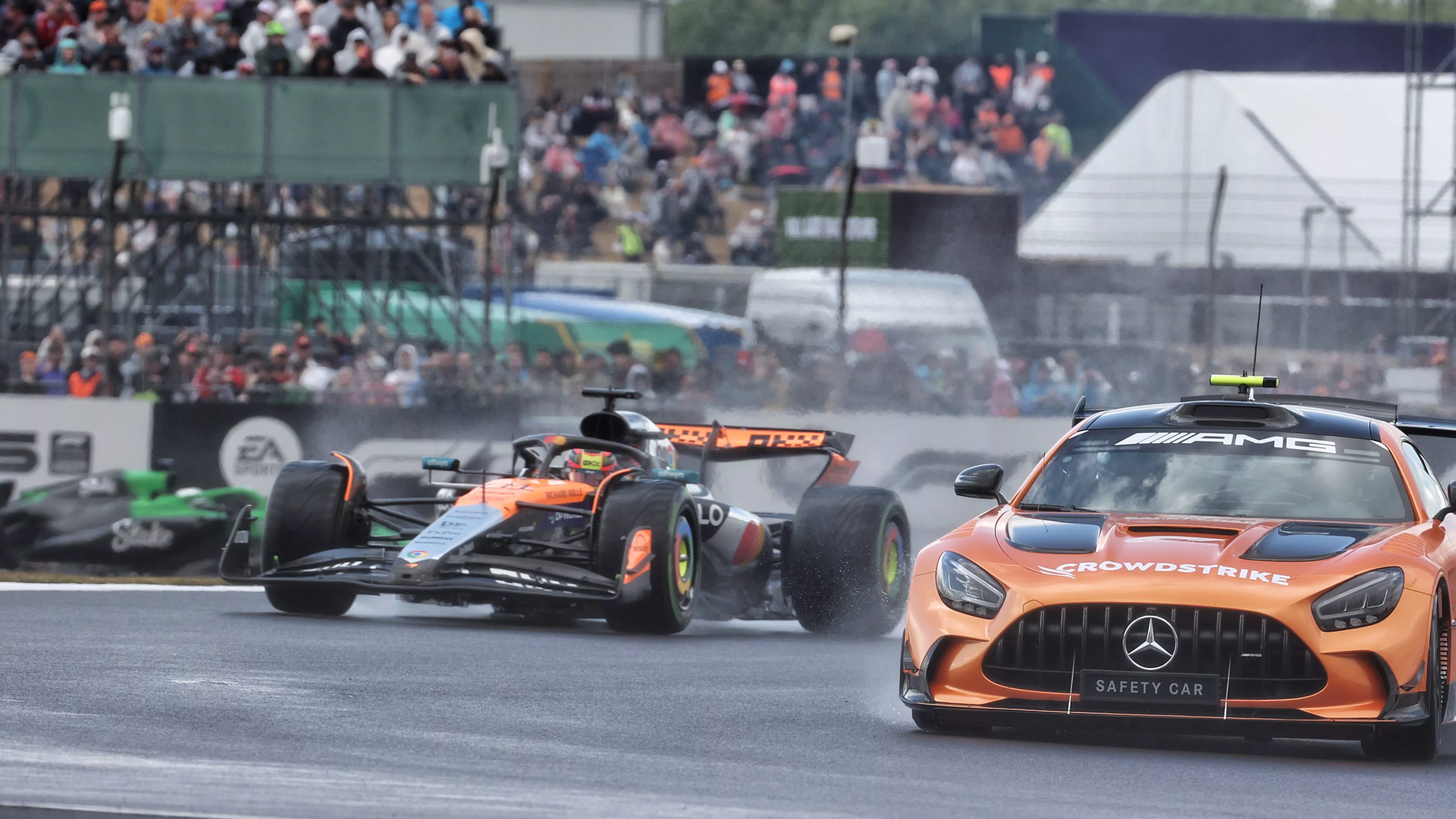
McLaren F1 car in rain behind safety car

It’s meteorology, not metrology, but the science is still precise: The FIA's deal with Tomorrow.io brings satellite-backed, AI-driven forecasting to every team on the pitwall - and to the officials making the calls that affect the weekend's running.
Car, Innovation

Metrology, not meteorology – The measurement technology that has redefined precision engineering in F1

Weather has always been one of the least controllable variables in Formula 1. Teams and race directors have long made decisions - on tyres, session timing, restart windows - based on forecasts that were, by the standards of other industries, relatively crude.

That's changing. The FIA has partnered with Tomorrow.io, a weather intelligence company that runs its own satellite constellation and uses AI-driven modelling to generate hyper-local, frequently updated forecasts. 

The result is a step-change in the quality of weather data available to everyone in the paddock.
AI weather tool used by FIA

Screenshot of a Tomorrow.io page showing weather above the Bahrain International Circuit
Aston Martin F1 car exiting garage

Sign up for a newsletter and we'll make sure you're fully up-to-date in the world of race technology

What did weather forecasting in F1 look like before 2026?

Traditional weather models are physics-based: they take known atmospheric data and run it through numerical equations to project future conditions. The approach works, but it has limits. Coverage was uneven. 
 
As Tomorrow.io co-founder Itai Zlotnik explains: "In the past, 70% of the globe was not covered by observation, or it had very latent observation that was anywhere between one to three days old.”
 
That's a problem in motorsport, where conditions can change dramatically within a single session, and where a circuit sitting near a coastline - like Suzuka or Spa - can be subject to highly localised weather that regional models miss entirely.


What does AI actually change about forecasting?
Zlotnik is direct about the scale of the shift: "AI puts it on steroids. And in a good way, not as a buzzword." 

The practical difference shows up in development speed. "If something is not right and you need to refine it, something that would have taken two years in the past, takes today a week or so," he says. 
 
"AI did, over the last two to three years, for the atmospheric science world, the same stuff that would have taken six years in the past to improve."
 
It also handles complexity that previously resisted modelling. "Things that were extremely complex in the past, like the tunnelling effect, AI can help you crunch that very quickly."


The trajectory has shifted his view significantly: "If we had talked three years ago, I would probably say that AI will never replace things. We now see AI out-compete everything."

AI weather tool used by FIA

A rain forecast example from Tomorrow.io’s software
Max Verstappen sweating

What does it feel like to be an F1 driver in a ‘heat hazard’ race?

What does the FIA’s weather AI actually do differently?

Tomorrow.io operates its own constellation of small satellites - the DeepSky programme - which provides sub-hourly global observation data. Rather than waiting for ground stations or weather balloons, the system pulls in near-real-time readings from orbit, including over ocean areas where most weather systems originate.

"The unfortunate truth for us as humanity is that most of the world's weather system is derived from the ocean," says Zlotnik. "So if you have real-time observation of what's happening in the oceans - and if we think about a race where there is a cyclone nearby - then you have a chance to better predict what's going to happen."


The platform also generates probabilistic forecasts: a spread of possible scenarios with associated probabilities. That matters for decision-making, because knowing there's a high chance of a dry window in 25 minutes is more useful than a binary forecast.

"It is a major change in terms of the scope of the technology that we have available to us," says the FIA's Head of Information Systems Strategy, Chris Bentley.
AI weather tool used by FIA

Tomorrow.io’s AI software provides a summary and in-depth forecast for the days and hours ahead
Invicta F2 car

Car, Innovation

Inside Invicta Racing’s two-time Formula 2 championship-winning factory

Is this a ‘learning’ model? 

The AI integration is continuous, and it’s learning from past races.
 
"They give us information before a session, during a session and update us constantly," Bentley explains. "We need to know changing conditions, and if there's anything that will affect or delay running. That will allow us to schedule, reschedule and change things."
 
The practical application goes beyond formal Heat Hazard and Rain Hazard declarations to the more granular decisions about when to hold off on a restart, or whether conditions will improve enough to warrant waiting. 
 
If race control has reliable data showing a dry window will open up, that changes the calculus considerably.
 
The FIA has also fed years of its own historical weather data into Tomorrow.io's system - records from typhoon-affected weekends in Japan, the repeated rain chaos at Spa (including 2021), and other weather-impacted events. 
 
F1's particular requirements don't map cleanly onto standard forecasting needs: what matters isn't just rainfall, but how quickly a track dries, what standing water looks like under car spray, and how the first drops at marshal posts translate into track conditions.
 
Trackside cameras and the rain sensors at marshalling posts are also being integrated, feeding real-time ground truth back into the model.
AI weather tool used by FIA

Data includes temperature, wind speed and humidity

What do teams get out of AI weather forecasting? 
Each team has access to a bespoke portal displaying the specific weather data they want. These are interactive and were developed in consultation with the FIA to reflect what teams actually use in race strategy and set-up decisions.
 
Better short-term forecasting affects tyre strategy calls directly. It also has longer-horizon uses. 
 
"We moved Japan to a different part of the calendar due to effects of climate change," says Bentley. "With the data that we have from this, it also helps us in terms of the way we can look at the risks of when certain events are actually held."
F2 cars in rain

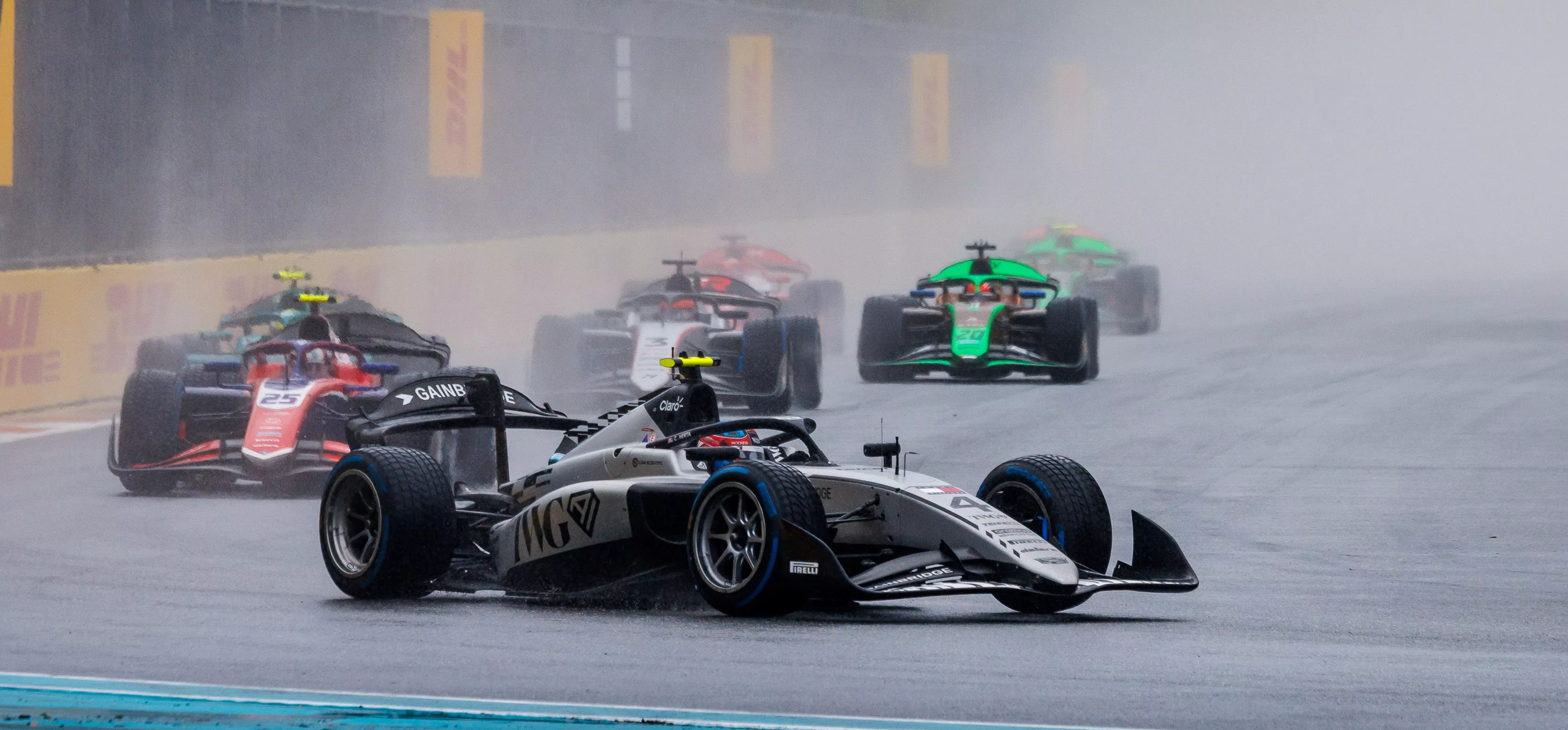
Formula 2’s Miami feature race was hit by rain in Miami - both this and the F1 Miami Grand Grix were re-scheduled due to weather
Vortex 3D render on F1 car front wing

Car

The role of the vortex and its effect on Formula 1 aerodynamics

The limits of AI weather modelling 

Zlotnik is direct: "When you're trying to predict Mother Nature, you need to be humble."


Weather modelling is a model, not reality, and the gap between the two never fully closes. 

The aim is to be reliable and trusted enough to support better decisions - not to claim infallibility against a system as complex as the atmosphere.
 
The data flow also runs both ways. "We hope the teams will feel that they're being listened to, and they will have faster updates, start their feedback loops, and we can build something unique based on the partnership," says Zlotnik. 
 
"So it's not about why we think Tomorrow.io is great. It's about what they need and what they want."
 
Just as a driver gets better as they turn laps of a circuit, this AI weather system learns. The forecasting gets better as the partnership generates more real-world data against which predictions can be validated - and it’s fascinating to see the results of early AI adoption in F1.

Related articles

Nurburgring 24 Hours

Event, Innovation, Future

Nurburgring 24 Hours: How Race Control manages the world’s longest racetrack

Xevi Pujolar and Zhou Guanyu

Career

Xevi Pujolar: The race engineer - what you don’t see on TV

Sign up to receive regular newsletters and ensure you stay ahead with exclusive articles on technological innovations and valuable insights into the world of motorsport

Make sure you're fully up-to-date in the world of race technology

By signing up, I acknowledge that I have read and understood the content of the Terms and Conditions