Innovation
The evolution of Formula 1 tyres: cross-ply, radial, and slicks explained
by George Wright
10min read
They squeal around corners, absorb huge forces, and are the primary tool for keeping drivers safe at incredible speeds. Across all surfaces from Formula 1 down to karting, tyres are a vital and continually evolving component of motor racing.
Sign up for a newsletter and we'll make sure you're fully up-to-date in the world of race technology
While every Formula 1 car from the dawn of the sport has relied upon them, the tyres of today and those of the 1950s are almost incomparably different.
This evolution has been the result of a process of continuous and enormous development, which has given rise today to some of the most advanced tyres in motorsport.
Getting a grip
Even at a glance, the tyres of an early Formula 1 car are obviously a far cry from those of today.
F1 cars in the 1950s used narrow tyres of the same width both front and rear. These almost resembled a motorcycle tyre more than those of a modern car - Formula 1 or otherwise. The narrow tyres minimised drag, but also provided a very small patch of rubber actually touching the ground, severely limiting grip. Combined with the absence of downforce at the time, this made cars of the 1950s a particular handful to drive.
Despite this, narrow tyres remained in use well into the 1960s. After 1951, engine power in F1 steadily decreased, particularly with the introduction of a 1.5-litre engine formula in 1961. As such even narrow tyres did not have much trouble putting the horsepower these cars produced onto the ground, so manufacturers were content to stick to the familiar narrow profile.
.webp?cx=0.5&cy=0.5)
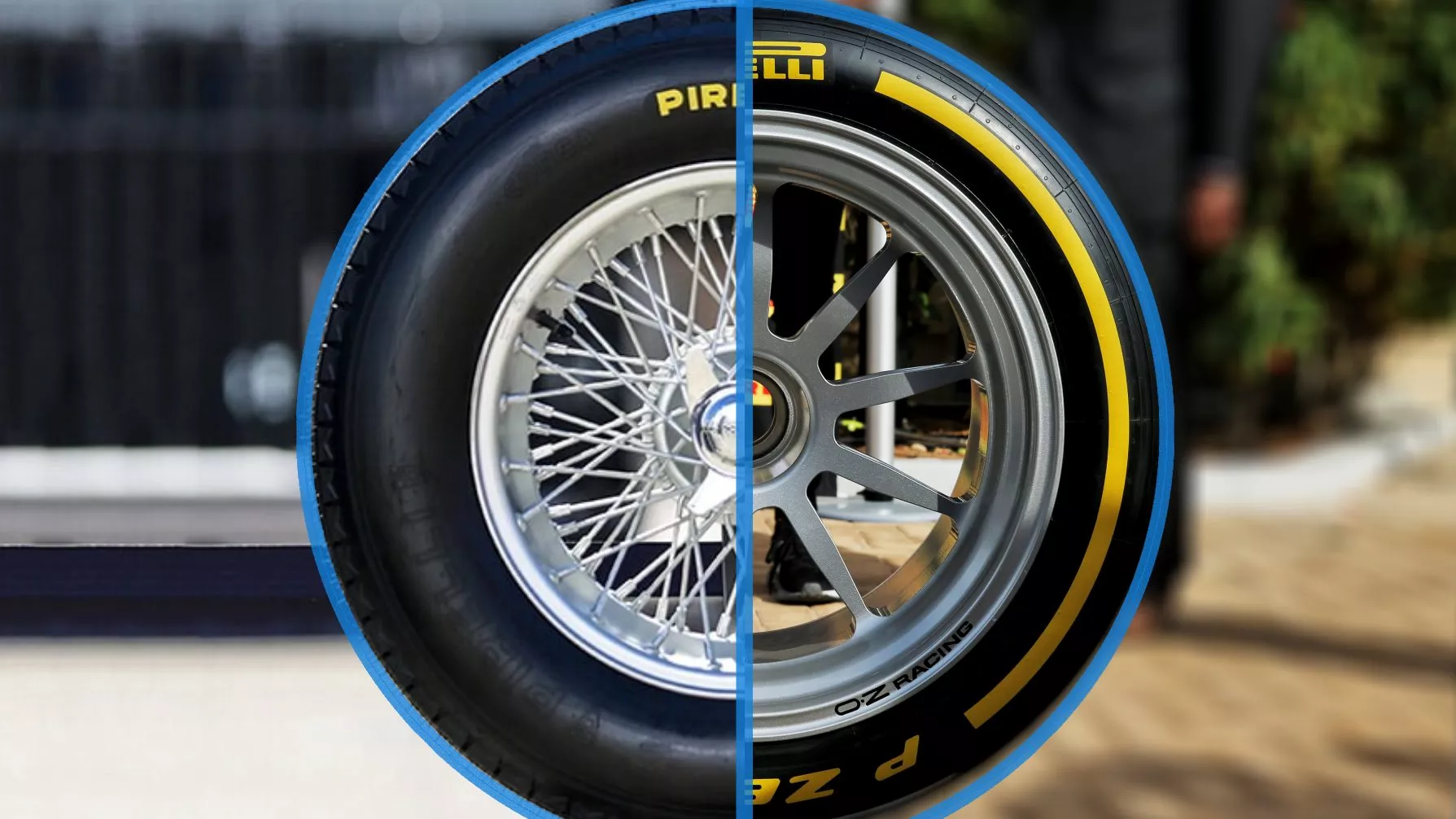
A recreation of the ‘Stella Bianca’ tyre that was used by some F1 teams in 1950 - image courtesy of Pirelli
Things changed in the mid 1960s, particularly in 1966 when a new 3-litre engine formula was introduced, sending power outputs rocketing upwards.
Manufacturers began supplying much wider tyres in response to the challenge. In principle, this may seem to have little impact on grip: the typical formula for calculating friction does not take contact area between surfaces into account.
However, this formula only holds true for rigid materials. Contact area is not only a factor with flexible materials such as rubber, it can also achieve a higher coefficient of friction than is possible in the conventional model of friction. As a result, wider tyres do in fact increase grip, with their increased thermal mass reducing temperature-related degradation for good measure.
1966 also saw the introduction of F1’s first ‘tubeless’ tyres, which did away with a separate air-filled inner tube in favour of sealing air between the wheel rim itself and the tyre.
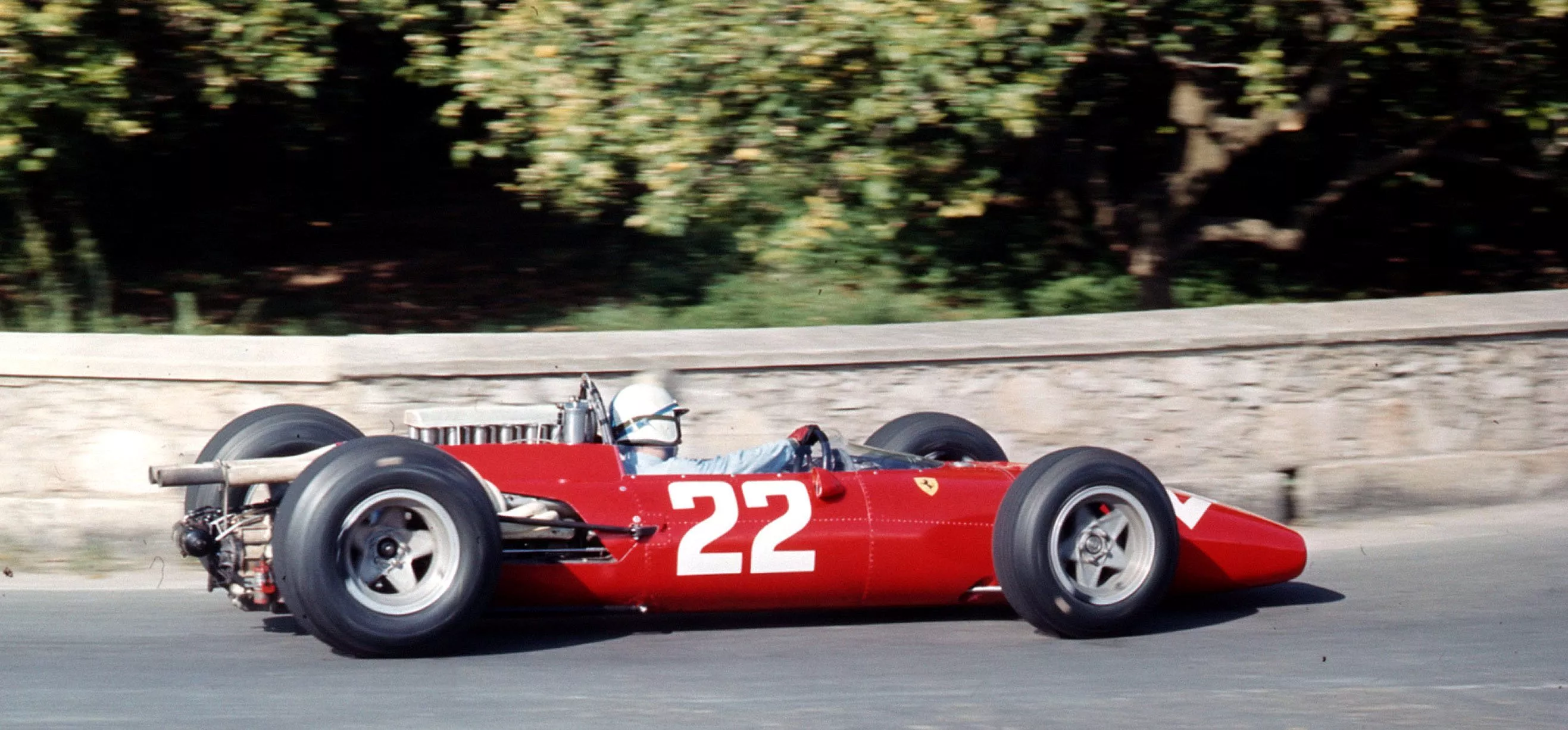
John Surtees at the wheel of the Ferrari 312 at the 1966 Syracuse Grand Prix
This served to reduce the likelihood of punctures and also enabled lower tyre pressures to be used. Even with these improvements though, as the 3-litre engine era progressed, it began to look like tyre development couldn’t keep pace with that of engines. Some teams, therefore, briefly looked towards four-wheel drive as a way of solving their traction problems.
However, another
solution to these issues arose at the 1971 Spanish Grand Prix when
Firestone introduced Formula 1’s first usable slick tyre.
Prior to this development, even dry weather tyres were treaded, as the rubber compounds available in the ‘50s and ‘60s did not have enough flexibility to properly conform to the track surface when applied to a completely smooth tyre. Breaking up the tyre surface into smaller tread elements helped to increase its compliance and mitigate this issue.
The development of new synthetic rubber compounds enabled tyres to be made softer than before, meaning tread could be done away with. This further enlarged the tyre’s contact patch, while the softer compound also inherently conformed better to irregularities in the track surface. Combined with the advent of aerodynamic downforce, these new tyres helped provide perhaps the greatest leap in car performance in F1 history.
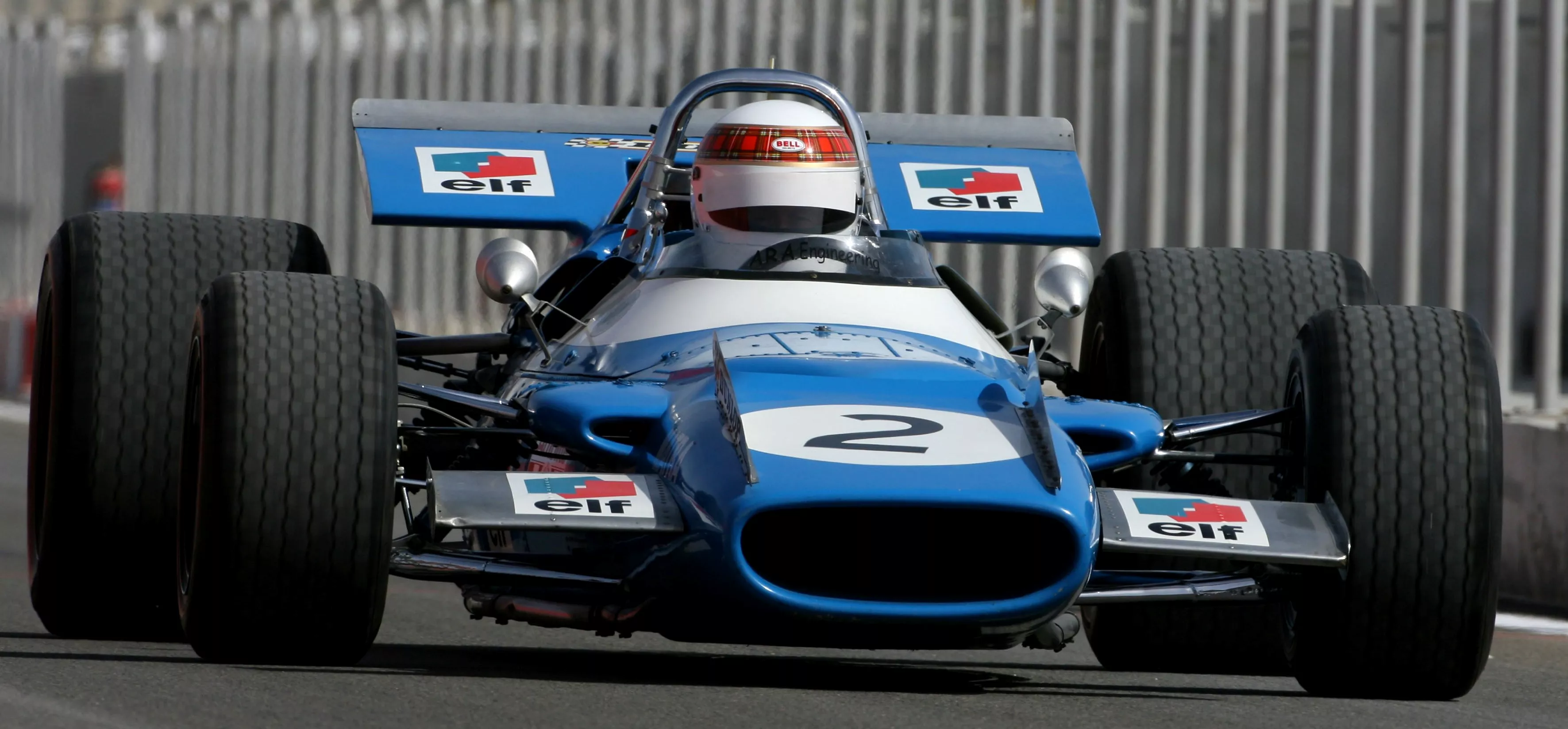
The 1969 Matra MS80 (pictured in 2010) with treaded tyres visible
The radial revolution
Despite these
innovations, the construction of F1 tyres in the mid 1970s still had
much in common with those of a quarter of a century earlier.
Pneumatic tyres get their structure from a series of cords made from hard-wearing materials such as polyester, Kevlar or steel, which are called plies. All early F1 tyres used a ‘cross-ply’ (or bias-ply) construction, where these plies run diagonally across the tyre, and are built on top of each other in alternating layers. If the first layer of plies runs diagonally from left to right, the next layer runs diagonally from right to left. This forms a distinctive ‘cross’ shape which gives the tyres their name.
.webp?cx=0.5&cy=0.5)
A render showing across-ply tyre where plies of material run diagonally across the tyre
In 1977 Michelin joined F1, bringing with them new radial tyre technology, which would usurp the cross-ply tyre structure that had been used since the sport’s earliest days.
In a radial tyre, only a single layer of ply is used, which runs in parallel directly from one side of the tyre to the other. This layer is stabilised using a wide belt made of steel or Kevlar, resulting in a tyre with a flexible sidewall yet a more durable tread surface than that of a cross-ply tyre.
Michelin initially provided its radial tyres exclusively to the Renault team, but soon expanded to supply others. When Ferrari won the world championship on the trailblazing French rubber in 1979 it was a wake-up call to many, with other firms such as Pirelli developing radial tyres of its own. By 1984, every manufacturer on the grid had made the switch to radial tyres, which remain the standard in F1 to this day.
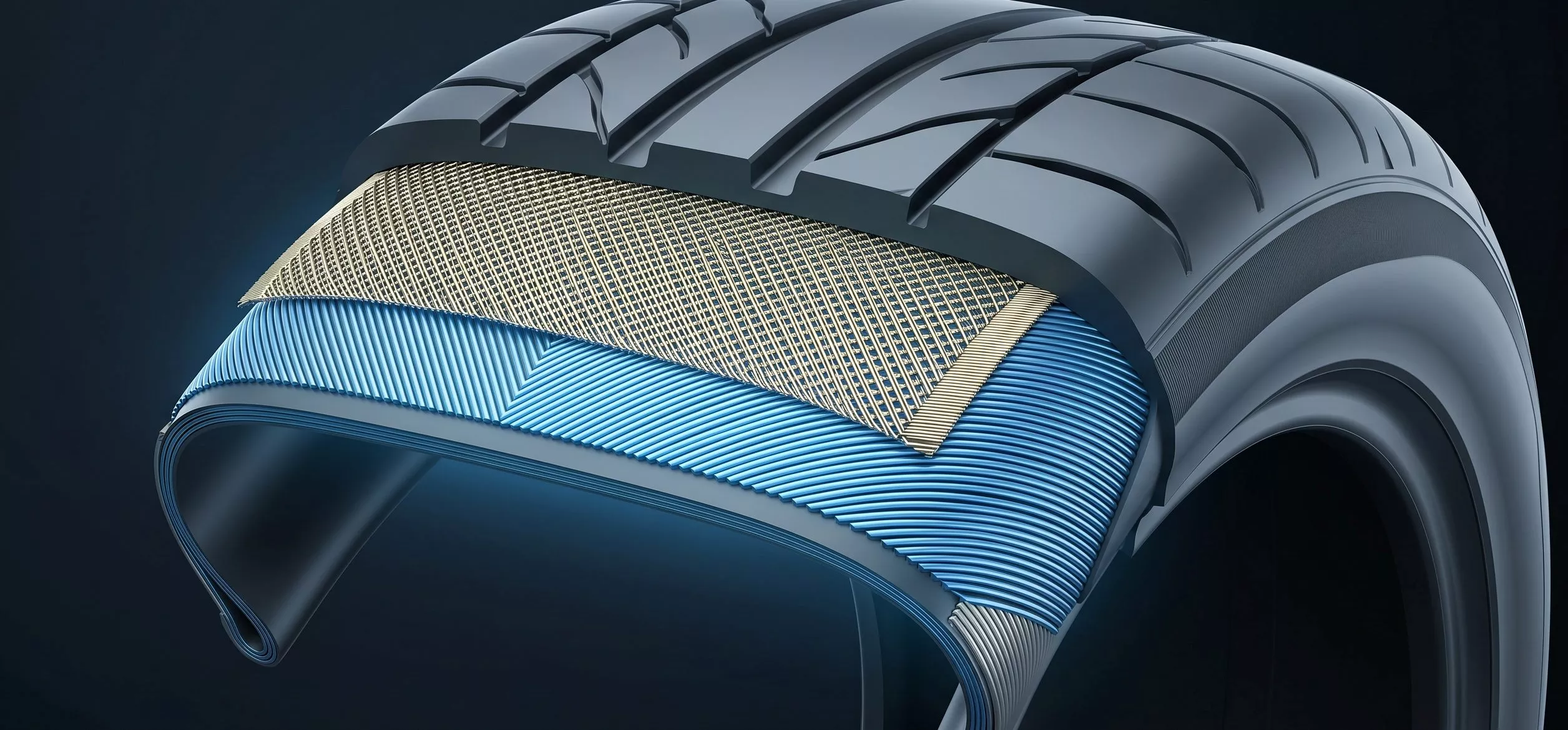
A render showing a radial tyre, with the middle layer - a belt made of steel or Kevlar -strengthening the tyre
The tyre wars
From the 1980s to the 2000s, competition between tyre manufacturers reached new heights. Vast sums of money were spent on development, giving rise to phenomena like special super-grippy tyres purely for qualifying.
The benefits of these were minor, but once one manufacturer had introduced them, rivals had to follow suit to avoid being left behind. Understandably, this technological battle led to the term “tyre war” becoming an established part of the F1 lexicon.
Rule changes also played a key part in the development of tyres during this period. In 1993, the FIA became concerned with the cornering speeds being achieved by F1 cars.
It responded by introducing regulations which reduced maximum tyre widths to 381mm for rear tyres (down from 457mm) and 279mm (from 330mm) for fronts. This came with a concomitant reduction in grip, one that was supposed to slow cars down and improve safety.
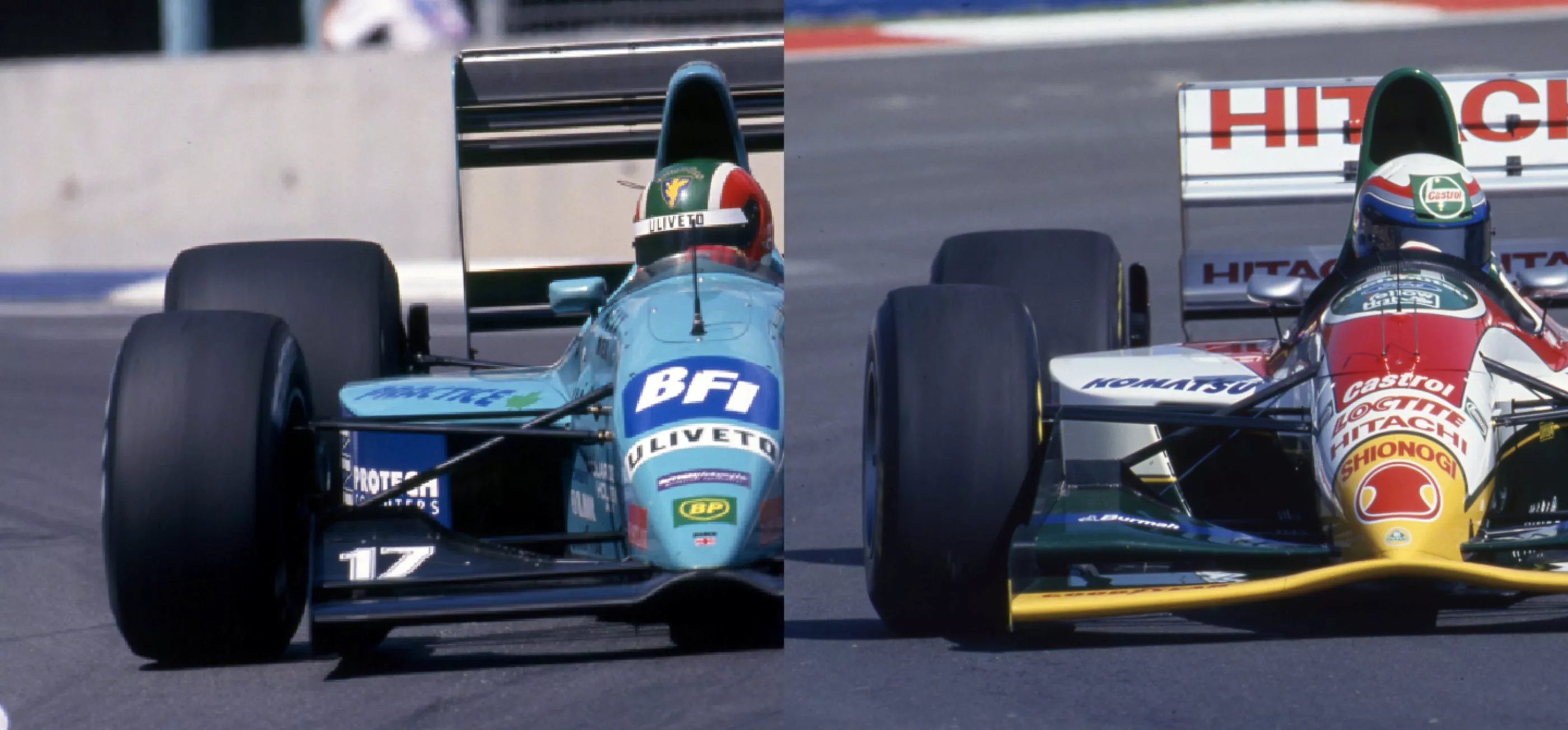
Tyres were narrowed in 1993 (R, Lotus 107B) from 1992 (L, March CG911B), to reduce grip, cornering speeds, and increase safety
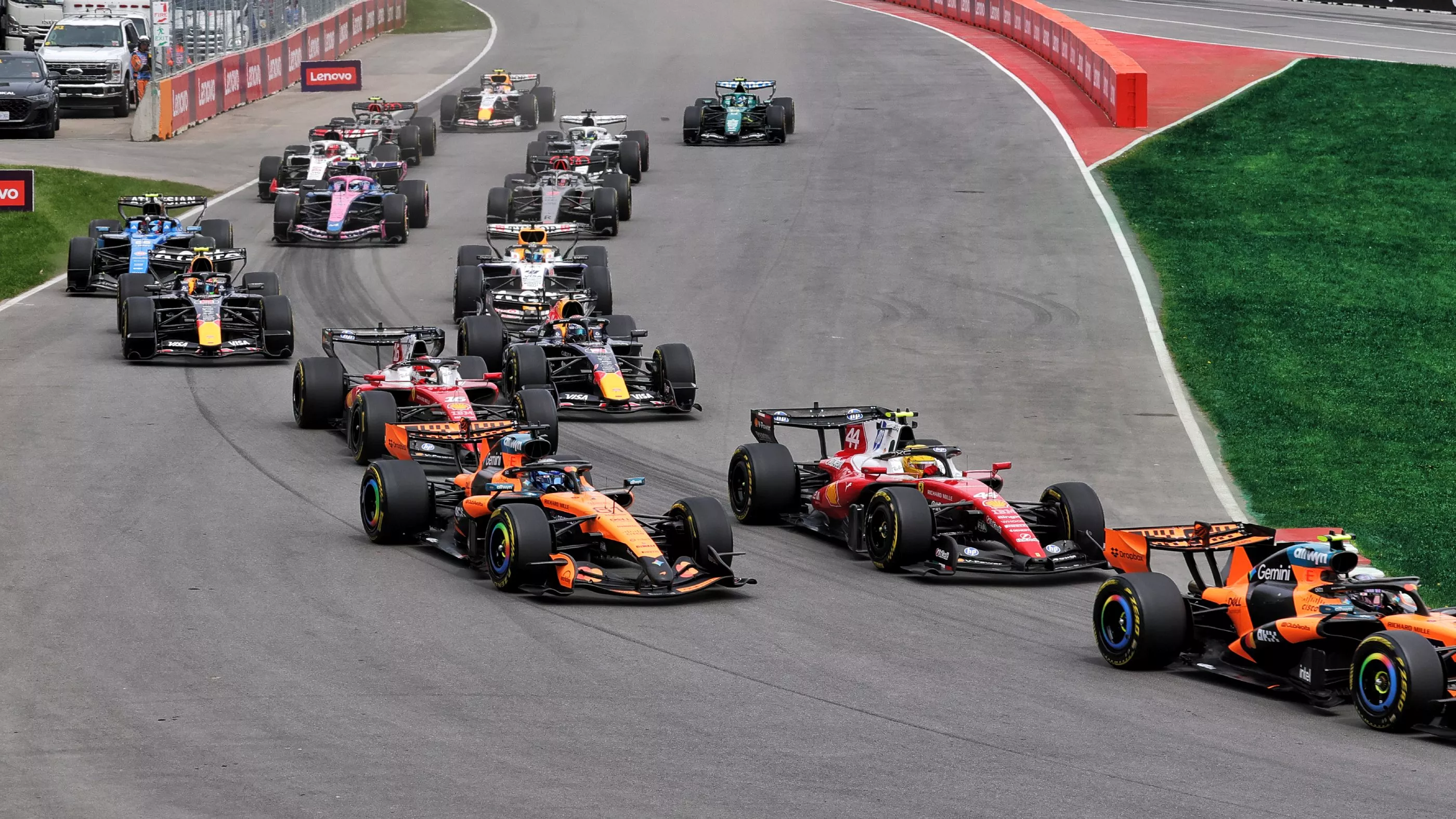
The FIA continued this approach in 1998 by resurrecting an idea from the early 1980s to mandate tyres which featured grooved surfaces to further reduce speeds. This was not a return to the full treaded tyres of the past, as the grooves ran parallel to the tyre’s direction of rotation, but it still marked F1’s first season without slick tyres since their introduction in 1971.
If anything, the 1998 rule changes intensified the tyre war, particularly when Michelin rejoined the sport in 2001. In its quest for supremacy, it notably developed tyres which expanded as they wore, providing a larger contact patch than would ordinarily be allowed. This led to controversy during the 2003 season, with protests forcing a change in tyre design that ultimately proved crucial in that year’s title battle.
.webp?cx=0.5&cy=0.5)
A grooved Michelin tyre being fitted to a McLaren at the 2003 Australian Grand Prix
Rival firm Bridgestone
sought to maintain the position of dominance it had enjoyed since the
departure of Goodyear after 1998, and established a close working
relationship with the Ferrari team. Bridgestone produced tyres which
were ideally-suited to Ferrari’s multi-stop ‘sprint’ style of
racing, which made for a devastatingly effective combination.
As a result, the Japanese firm claimed five world championships between 2000 and 2004 with Michael Schumacher and Ferrari.
This dominance, in many ways, brought an end to the era of tyre wars. Looking to reduce Ferrari and Bridgestone’s advantage, in 2005, the FIA banned tyre changes during pitstops, forcing suppliers to move to harder rubber compounds which could last a full race distance.
Ferrari did indeed take
a notable step backwards in the wake of the changes, but the new
rules also brought unintended consequences. At the 2005 United States
Grand Prix, the otherwise dominant Michelin tyres proved unable to
hold up to the strain of the Indianapolis circuit’s banked and
abrasive final corner.
Multiple Michelin-shod cars suffered punctures during practice, and with tyre changes banned and a compromise unable to be found, the affected teams were forced to withdraw from the race. This left only six starters, and while the tyre change ban was reversed the following year, the damage had been done. Michelin duly announced late that season that it would leave F1 at the end of 2006, with Bridgestone taking up a role as F1’s sole tyre supplier from 2007 onwards.
.webp?cx=0.5&cy=0.5)
The Michelin-tyred teams abandoned the start of the 2005 United States Grand Prix at Indianapolis, leaving just six cars on the grid
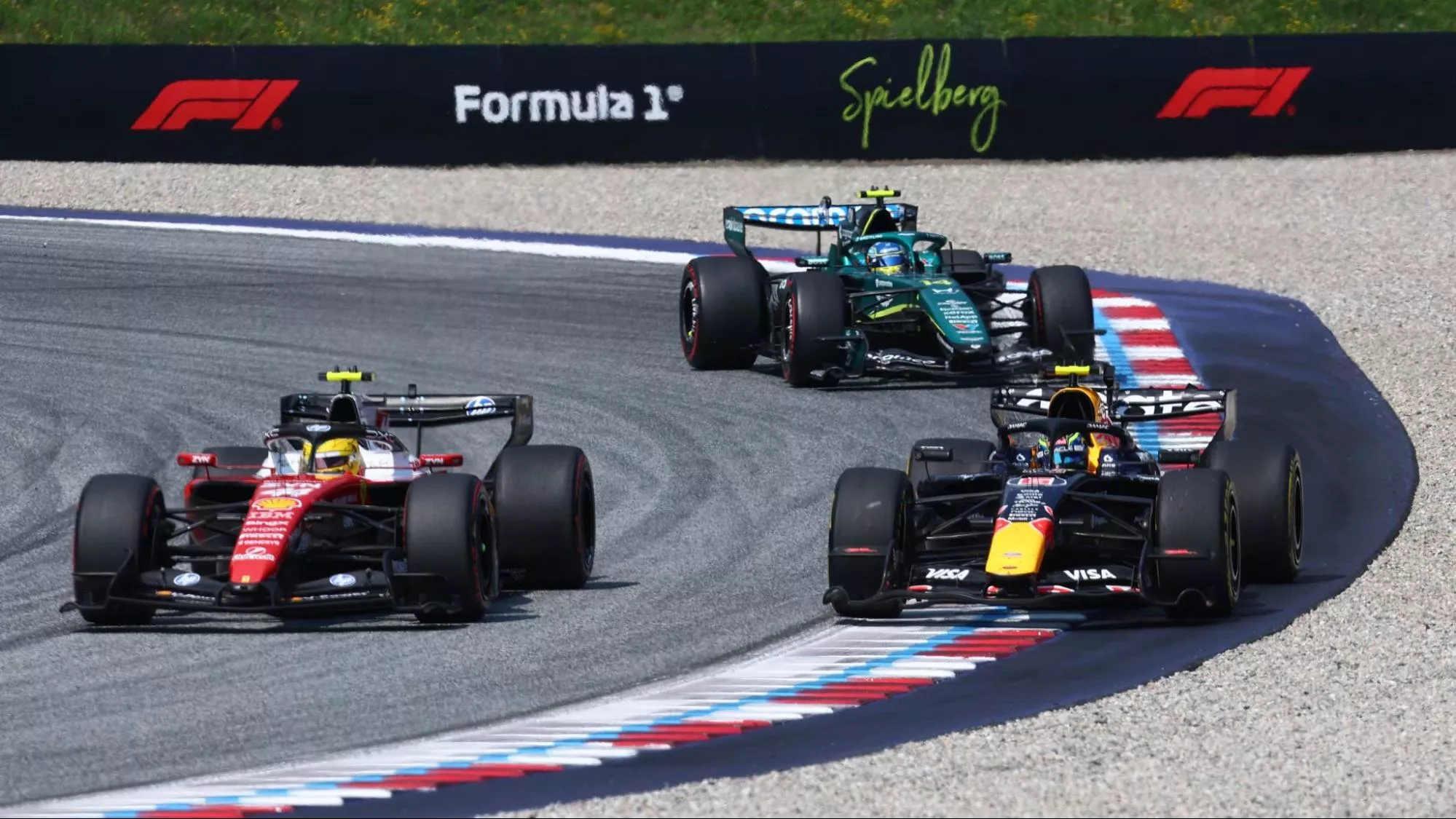
Modern F1 tyres
During its tenure as sole supplier, Bridgestone opted to supply teams with relatively robust tyres which could be pushed hard without fear of excessive degradation. Even a major rule change in 2009 which brought back slick tyres did not change this approach.
These tyres were generally liked by drivers, but also tended to reduce strategy variation. The introduction of a rule mandating use of two different tyre compounds per race in 2007 attempted to mitigate this factor.
This approach was contrasted by that of Bridgestone’s replacement Pirelli, which took over as tyre supplier in 2011.
Prior to that season the FIA specifically instructed Pirelli to develop tyres which degraded relatively quickly, so as to spice up races by encouraging multiple pitstops. The Italian firm did exactly as had been called for, but then faced criticism from some fans, who lamented that the new tyres could not be pushed for a large proportion of the race like in previous years. This served to demonstrate how in this new era, any firm supplying F1 tyres would be scrutinised not only on performance, but also on factors such as how its tyres impact the quality of racing.
.webp?cx=0.5&cy=0.5)
Pirelli became F1’s sole tyre supplier in 2011
Nevertheless, Pirelli’s aim has continued to be for most races to require two pit stops. Meeting this goal is a challenge, as testing in modern Formula 1 is heavily restricted. In earlier years, a team could visit a track before the race and test to its heart’s content to determine the ideal tyre compound for that circuit.
Pirelli, by contrast, has to rely on a combination of data from previous races and simulations of expected wear characteristics based on factors such as the track layout and type of surface to inform the compounds it provides to the teams.
The testing restrictions are particularly key during regulation changes such as those in 2017, 2022 or 2026. Pirelli often has to develop its tyres without access to an actual car built to the new regulations. It therefore relies on a combination of virtual models and mule cars (modified cars from previous regulation cycles) to simulate the expected performance characteristics of new regulations during development.
The 2017 rule changes
proved particularly demanding, bringing a move to heavier,
high-downforce cars which would put huge strain on their tyres.
Simultaneously, the new rules enlarged tyres to dimensions which had
not been seen since 1992. In the end, these factors combined to
result in the fastest generation of cars in F1 history.
That regulation cycle
lasted until 2022, when new rules were introduced that were similarly
impactful on tyres. A move from 13-inch to 18-inch wheels
necessitated lower-profile tyres with smaller sidewalls, more similar
to those of a road car. This change brought advantages such as a
reduction in overheating and overall degradation, but also presented
challenges.
.webp?cx=0.5&cy=0.5)
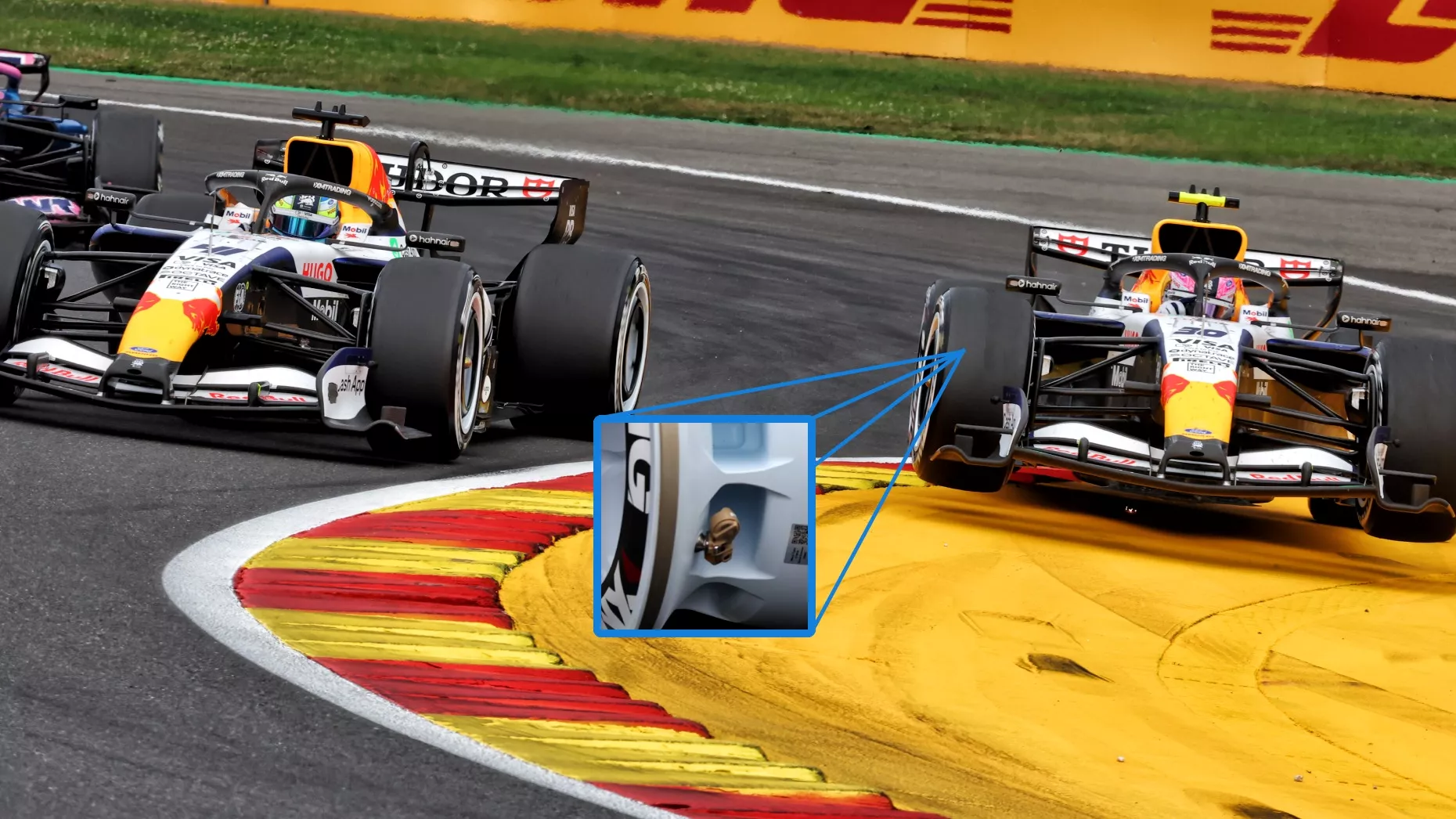
Pirelli displaying the three compound choices on the 18" wheel rim, with soft, medium and hard compounds denoted by the red, yellow and white sidewall markings respectively

The demands of the current 2026 tyre regulations almost seem slight in comparison, with Pirelli’s former head of motorsport Mario Isola noting that the latest generation of car has been relatively gentle on tyres compared not only to previous regulations cycles, but also to the expected levels of wear prior to the start of the season.
Nevertheless, Pirelli has not been able to rest on its laurels. Once again the dimensions of tyres have changed, with the quest for smaller cars leading to front tyres being made 25mm narrower, and rears 30mm.
It has also had to try to anticipate how the cars will develop over the course of the season, leading to compounds which may seem conservative initially, but which are anticipated to become more marginal as the year progresses and teams find ways to pile more downforce onto their cars.
While perhaps somewhat detached from the major performance leaps provided by early tyre revolutions such as the arrival of radial tyres, this philosophy is nevertheless testament to the fine margins and continuous improvements which define modern Formula 1.
.webp?cx=0.5&cy=0.5)